
OmniClean 300W Pulse Laser Cleaning Machine
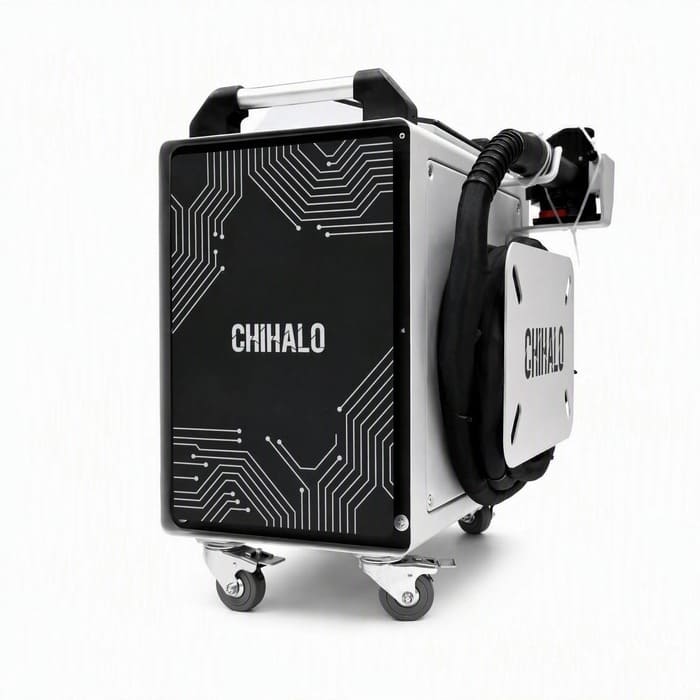
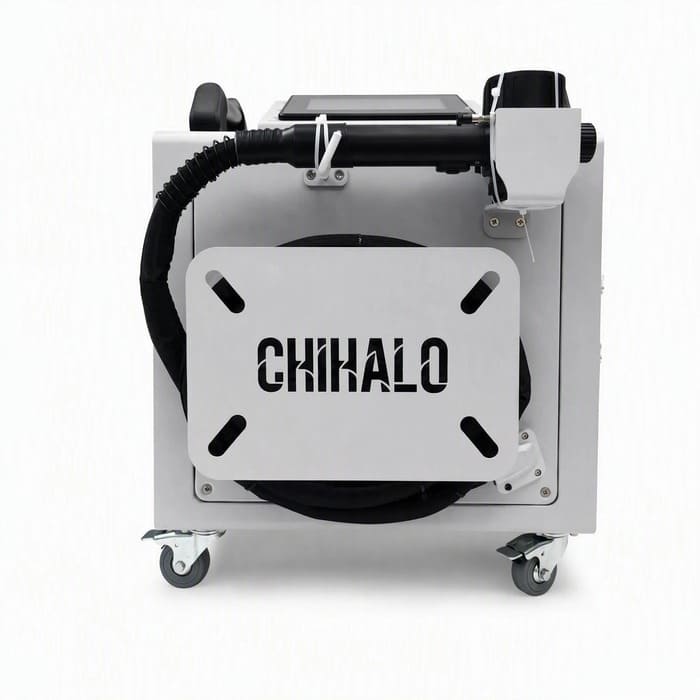
The OmniClean 300W is a handheld MOPA pulsed laser cleaning machine built on a Max Laser 300M source. It costs $6,500 factory-direct and ships in 7 days.
1.8mJ / 5mJ / 15mJ for Option
110V-220V Wide Range
- Non-Burning cleaning of wood surface
Below you will find our own test results on steel, wood, marble and moulds,
including what the machine could not do.

Hi! I am Dawn. With 10 years of field experience, I specialize in laser cleaning systems—from optical sourcing to automation. I write here to turn complex specs into actionable buying guides.
Last Updated: 2026/11/4 Published: December 5, 2025
1. Why Choose OmniClean 300W?
Most 300 W cleaners are built around a similar fiber source, so the differences show up in pulse energy options, cooling, weight and what you actually pay.
| OmniClean 300W | Lasers Only CL300JPT | HantenCNC 300W | Cloudray CL-300 | |
|---|---|---|---|---|
| Price | $6,500 factory-direct | $11,199 published | On request | On request |
| Pulse energy | 1.8 / 5 / 15 mJ, your choice | 5 mJ fixed | 15 mJ | Not published |
| Max frequency | 8000 kHz | 3000 kHz | 3000 kHz | Not published |
| Pulse width | 10–500 ns | 13–500 ns | 13–500 ns | Not published |
| Cooling | Air | Air | Water | Air |
| Machine weight | Under 24 kg | 86 lbs crated | About 80 kg | 18.8 kg |
| Head weight | Under 1 kg | Not published | Under 1.25 kg | Lightweight |
| Scan speed | Up to 25,000 mm/s | Not published | Not published | 18,000 mm/s |
| Voltage | 110–220 V | 110 V | Not published | Not published |
| Lead time | 7 days | Not published | Not published | Not published |
Competitor figures are taken from the manufacturers’ own product pages as of November 2026. Prices change, so check before you compare.
Where the alternatives are the better buy
If you need a US-based service contract, next-day parts from a local warehouse or a supplier you can visit, a US or European distributor is worth the premium.
The Cloudray unit is lighter than ours if portability is the only thing that matters to you.
HantenCNC’s water-cooled design suits continuous high-duty work in a fixed location, where an 80 kg machine is not a problem.
What you should not pay for is the same Chinese-built machine with a different badge on it and a 70% markup. That is the gap this page is about.
300W MOPA Pulse is the sweet port
Many customers ask: “Should I buy a 200W or a 300W laser?”
The 300W MOPA pulse laser is widely considered the “sweet spot” for industrial applications. It offers 50% more pulse energy than 200W models, allowing you to clean thicker rust layers and tougher paints significantly faster, without the high cost of 500W systems.
It is specifically engineered for precision cleaning where preserving the substrate texture is critical.
Video Analysis:
- Material: Heavy Rust on Carbon Steel (Grade C).
- Time: 30 Seconds.
- Substrate Temperature: <50°C (Safe to touch).
Efficiency Benchmark:
A generic 100W laser cleans rust at ~2 m²/hour.
Our 300W JPT Laser cleans rust at ~6-9 m²/hour.
It triples your productivity without sacrificing precision.
2. Why 1.8mJ / 5mJ / 15mJ Energies Matter
Most 300 W cleaners ship with one fixed pulse energy. The OmniClean lets you choose, and the difference shows up in how low you can take the frequency while still running at full power. Also it’s decided by your applications!
| Version | Full power from | Price |
|---|---|---|
| 1.8 mJ | 165 kHz | $6,500 |
| 5 mJ | 60 kHz | $6,500 |
| 15 mJ | 20 kHz | $6,500 |
All three cost the same. Choose based on the work, not the budget.
In short, 1.8mJ is for most of the cleaning applications, including wood surface paint stripping, rust cleaning and paint on metal. 5mJ and 15mJ are more suitable for sensitive surfaces that should have the smallest influence, like mold.
Lower frequency at full power means more energy in every pulse, and that is what lifts thick coatings and heavy scale. If you run a 1.8 mJ source below 165 kHz, the laser reduces its output to protect the amplifier — the energy drops with the frequency, so you gain nothing. Pulse width is adjustable from 10 ns to 500 ns and the source also runs in continuous mode, so one machine covers both pulsed and CW work.
Not sure which version fits? Send us a sample or a photo of the part. We will run the test and send you the video with the settings we used.
3. Real Tests of OmniClean 300W Pulse Laser Cleaning Machine
Every figure below comes from our own lab. We state whether the test used the handheld head or a galvo workstation, because the two are not comparable — a handheld pass covers far less area per hour than a fixed workstation.
Wood Surface Laser Cleaning
Wood is the hardest material to get right. Too much energy and you scorch the grain; too little and the finish stays on.
The OmniClean ships with saved parameter presets for wood, and the cleaning head carries a ring-type air knife that clears debris and heat from the working zone as you go. The air knife is part of the standard head, not an add-on, and it has its own pre-blow and post-blow timing so debris is cleared before the beam fires and after it stops.
In our tests on painted furniture, paint and varnish lifted without damaging the fibres. We also found two limits: coatings containing glue leave a residue you have to scrape off, and thick multi-layer finishes need several passes.
As with any wood work, test on a hidden area first. Send us a sample and we will find the settings for your specific finish.
Metal Rust and Paint Cleaning
4. Real-World Performance Data
Before

After

Cleaning Test
Material: Carbon steel wheel hub
Laser model: MOPA300W-1.8mJ
Removing materials: surface rust, oil stains, oxide layers, etc
Field lens model: F160/F254
Cleaning parameters: pulse width of 500ns; frequency of 165kHz; Power 100%; Speed 25m/s
Cleaning efficiency: Handheld cleaning, approximately 20min per small wheel hub and 25min per large wheel hub
Before

After

Cleaning Test
Material: Aluminum paint board
Laser model: MOPA200W-1.8mJ
Material removal: Black paint (0.3mm thickness)
Field lens model: F160
Cleaning parameters: pulse width of 500ns; frequency of 110kHz; Power 40%; Speed 13m/s
Before

After

Cleaning Test
Material: Stainless steel roughening
Laser model: MOPA1000W-2mJ
Field lens model: F254/Pulse width: 200ns/Frequency: 1000kHz/Power: 70%/Speed: 6000mm/s
Processing size: 100mm * 100mm
Effect: Sa13.64um, depth 104um
Processing time: approximately 17 seconds
Before

After

Cleaning Test
Material: Copper nickel plating
Laser model: MOPA300W-1.8mJ
Field lens model: F160
Parameters: Pulse Width: 500ns/Frequency: 165kHz/Power: 100%/Speed: 1500mm/s
Effect: First scan once with 500ns, then clean with 200ns to remove the layer of nickel plating on the copper surface
Processing size: 9mm × 8mm
Processing time: about 3 seconds
Before

After

Cleaning Test
Material: Copper
Laser model: MOPA300W-15mJ
Pulse width: 500ns
Frequency: 20kHz
Power: 95%
Speed: 20000mm/s
Processing effect: Clean surface pollutants without damaging the surface of the grinding tool
Processing efficiency: complete set efficiency of 2.5min
5. Built for People Who Run It Every Day
Read laser alarms on the machine itself
On many machines, when the laser source throws an alarm you have to connect a laptop, install the source manufacturer’s software and plug in a separate cable before you can even see what the fault is. Most operators never do it — they call the supplier and describe the symptoms instead.
The OmniClean reads the source alarm signals directly and shows them on the touchscreen. No laptop, no vendor software, no extra cable.
Eight saved jobs, one button away
Store up to eight parameter sets and recall them by number. A furniture shop might keep one for latex paint, one for varnish, one for oak and one for pine. Switching material is one selection, not a re-tune. Each preset stores fill spacing, galvo speed, scan pattern, graphic size, power, frequency, pulse width and scan count.
Change field lens without recalibrating
F254 is fitted as standard, with F160 and F330 available. Select the lens on screen and the controller applies the correct XY scaling automatically.
- F160 — up to 100 × 100 mm, tighter spot, precision parts and detail work
- F254 — up to 150 × 150 mm, the general-purpose choice
- F330 — largest working area, for covering ground quickly
Operate it from the head, not the screen
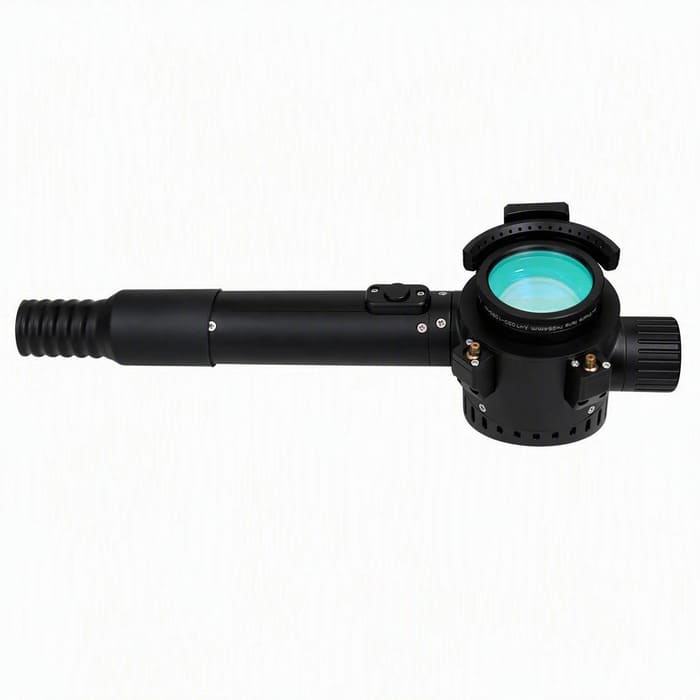
Enable external control and the button on the cleaning head runs the laser. Double-click to keep the beam on for continuous work, click once to stop. The head weighs under 1 kg, so you can work one-handed on awkward parts and hold the workpiece with the other.
6. Price and What's Included
$6,500 factory-direct, any pulse energy. Ships in 7 days.
Price is FOB and excludes shipping and import duties. Ask us for a delivered price to your country.
In the box
- Max Laser 300M fiber source, 305 ± 3 W
- Handheld cleaning head with ring-type air knife, under 1 kg
- Two field lenses: F254 fitted, plus one of F160 or F330
- 5 spare protective lenses
- 2 pairs of laser safety goggles
- 5 m fiber cable
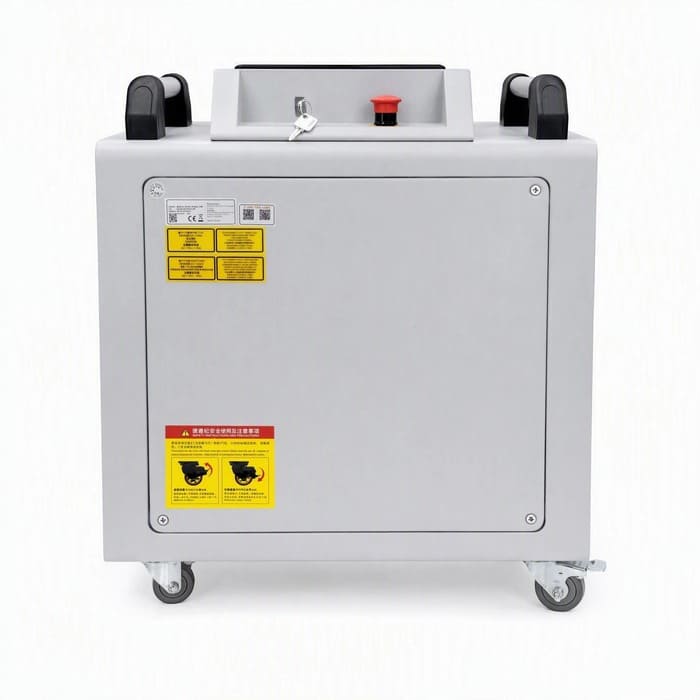
- Safety interlock
- Wood Box Package
Optional
- 10m Fiber Cable
- Laser Curtains 1.8*2m with steel installation Fixture
- Smoke Purifier
- Automatic Air Supply Respirator
- Laser Goggles
- Laser Caps
- Protective Lens
- F-theta lens
…
Buying on Payment Terms
If you sell on installments, or you are buying one, the OmniClean supports payment-staged unlocking.
Each payment stage has its own unlock code, and the machine locks both the laser source and the control system together if a stage goes unpaid — not just the control board, so a control card swap does not get around it.
For dealers, this means you can close customers who cannot pay in full up front, without carrying the default risk yourself.
For end users, the staging is set in your purchase contract before anything ships. Once the final payment clears, the unlock is permanent. There is no subscription and no remote access outside the agreed payment schedule.
Terms are arranged case by case.
7. Full Specifications
Laser source
| Source | Max Laser 300M MOPA fiber |
| Mode | Pulsed and continuous |
| Wavelength | 1060–1070 nm |
| Average output power | 305 ± 3 W at 25 °C |
| Pulse energy | 1.8 mJ / 5 mJ / 15 mJ |
| Full power frequency range | 165 kHz+ (1.8 mJ), 60 kHz+ (5 mJ), 20 kHz+ (15 mJ) |
| Repetition rate | 1–8000 kHz |
| Pulse width | 10–500 ns, adjustable |
| Fiber cable | 5 m |
Machine
| Power supply | 110–220 V |
| Power consumption | Under 1500 W |
| Cooling | Air-cooled |
| Dimensions | 452 × 376 × 538 mm |
| Net weight | Under 24 kg |
| Laser class | Class 4 |
Cleaning head
| Galvanometer | Dual-axis |
| Aperture | 10 mm |
| Field lens | F254 standard; F160 and F330 optional |
| Scan area | Up to 100 × 100 mm (F160), up to 150 × 150 mm (F254) |
| Air knife | Ring-type, 6 × 4 air tube |
| Scan speed | Up to 25,000 mm/s (F254) |
| Head weight | Under 1 kg |
| Operating temperature | 25 ± 10 °C |
| Storage temperature | −10 to +60 °C |
| Long-term drift | Under 0.2 mRad |
8. Who It's For and What It Can't Do
Who It's For
Restoration shops — furniture, cabinets, historic woodwork The head weighs under 1 kg and the air knife prevents flare-ups on wood. Start with 1.8 mJ.
Mobile cleaning contractors Air-cooled, under 24 kg, no chiller to transport, and it runs on 110 V. A seven-day lead time means you can quote work before the machine lands.
Fabrication shops — rust, scale, weld discolouration Our stainless plate test ran at about 3.6 m²/h on a galvo workstation.
Mould and tooling shops The 15 mJ version handles baked-on contamination. A full shoe mould set cleaned in about 2.5 minutes in our test.
Dealers and distributors Payment-staged unlocking, seven-day lead time, and OEM experience supplying two European laser brands.
Anyone comparing 300 W against 1000 W or more Read the 300 W against 1500 W test above before assuming more power is better.
What It Can't Do
Coatings mixed with glue leave a residue. Our wood tests showed paint containing glue does not lift cleanly — the residue has to be scraped off.
Aluminium substrates cannot be textured. The laser strips paint from aluminium cleanly, but will not texture the base metal underneath.
Curved surfaces give uneven results. On parts with significant curvature, consistency across the cleaned area cannot be guaranteed with a handheld head.
Heavy mill scale needs several passes. Rust usually clears in one pass; oxide scale took at least three in our pipe tests.
High-volume heavy steel may be faster with CW. If you are clearing heavy rust from large structural steel all day, a 1000–2000 W continuous machine covers ground faster. See our CW machines →
Accessories are not covered by warranty. The machine carries a one-year warranty; protective lenses, field lenses and fiber connectors are wear items and excluded.
9. Pulse (MOPA) vs. Continuous Wave (CW): The Truth
Why does a 300W Pulse machine cost more than a 1500W CW machine? Because they are different tools for different jobs.
- 1500W CW Laser: Like a “Flamethrower.” Highly efficient for removing rust from thick bridges or ship hulls, but the heat accumulation will warp thin sheet metal and destroy the texture of precision molds.
- 300W Pulse Laser: Like a “Scalpel.” It uses nanosecond pulses. The energy hits the contaminant and dissipates before satisfying the heat capacity of the metal underneath.
Application Rule:
- Cleaning a bridge beam? -> Buy CW.
- Cleaning an injection mold ($50k value) or engine parts? -> You MUST use 300W Pulse.
Frequently Asked Questions (FAQ)
Yes. The OmniClean ships with a 110–220 V supply as standard, so it works in North America without a transformer. Power consumption stays under 1500 W. At 110 V that is roughly 14 A under full load, so we recommend a dedicated 20 A circuit rather than sharing one with other equipment.
All three cost $6,500, so choose by the work. Lower pulse energies suit thin coatings, precision parts and delicate substrates; higher energies suit thick paint, heavy scale and baked-on mould contamination. Send us a sample or a photo and we will test it and tell you which version fits.
Seven days from payment to dispatch. We send photos and a test video of your actual machine before it leaves.
Yes. The 300W pOne year on the complete machine. Protective lenses, field lenses and fiber connectors are wear parts and excluded. Most faults are diagnosed on a video call using the alarm shown on the machine's own screen, and replacement parts ship directly to you.ak power density, making it effective at breaking down tough powder coatings, although it is slower than CW lasers for this specific task.
Shipping depends on destination and method. Duties are set by your customs authority and change over time, so check with a broker. We can quote a delivered price on request.
It is optional but recommended, particularly on paint and any coating that may contain lead. Laser cleaning releases the removed coating as fume, and lead paint carries additional regulatory requirements in many countries.
Yes. The 300W pulse laser has high peak power density, making it effective at breaking down tough powder coatings, although it is slower than CW lasers for this specific task.
Yes, through payment-staged unlocking, arranged case by case. See the payment terms section above.
Yes. The 300W pulse laser has high peak power density, making it effective at breaking down tough powder coatings, although it is slower than CW lasers for this specific task.
Absolutely. We provide pre-set parameter libraries for common materials (Rust on Steel, Paint on Aluminum, etc.). You can start cleaning within 10 minutes of training.
The system is virtually maintenance-free. There are no consumables (no dry ice, no sand). You only need to wipe the protective lens periodically.
Yes, we offer a 2-year warranty on the laser source and lifetime technical support.
No. This is the primary advantage of the "Pulse" technology. By keeping the pulse duration short (nanoseconds), the laser vaporizes the residue before the heat can transfer to the metal mold, preserving the mirror or matte finish perfectly.
It depends on the environment. In a clean room, maybe once every 3 months. In a dusty rust-removal shop, maybe once every 2-4 weeks. The lenses are inexpensive consumables (approx. 10−10−15 each).
Yes. We use export-grade fumigated wooden crates with moisture-proof wrapping. The machine is anchored inside the crate to prevent movement during sea/air freight.
Hi! I am Dawn. With 10 years of field experience, I specialize in laser cleaning systems—from optical sourcing to automation. I write here to turn complex specs into actionable buying guides.
Ready to order, or still deciding?
Don’t guess.
Send us your sample parts!
Tell us what you need to clean, the material, how thick the contamination is, and your country. We will recommend the pulse energy and send a delivered price within 24 hours.
We manufacture and sell laser cleaning machines. We do not offer on-site cleaning services.