
Laser Cleaner Machine: Prices, Types & Complete Buying Guide 2026
- Factory-Direct from a National High-Tech Enterprise
- 30-40% Below Dealer Prices
- Same Components as $5,000 Branded Units
Three reasons 500+ businesses chose us:
- We’re the OEM behind European laser brands (same factory, lower price)
- 2-year warranty with 48-hour parts shipping worldwide
- Real prices on this page—no “request quote” games
Price Range: $3,000 – $25,000 (depending on power and type)

Hi! I am Dawn. With 10 years of field experience, I specialize in laser cleaning systems—from optical sourcing to automation. I write here to turn complex specs into actionable buying guides.
Table of Contents
What is a Laser Cleaner Machine?
A laser cleaner machine (also called laser cleaning machine or laser rust remover) is an industrial surface treatment device that uses focused fiber laser beams at 1064nm wavelength to remove rust, paint, oil, oxide layers, and coatings through selective ablation.
The contamination absorbs laser energy and vaporizes instantly, while the base metal reflects the beam and remains undamaged.
Laser cleaners are available in two types: Pulsed (100W-500W, $5,000-$25,000) for precision work, and Continuous Wave/CW (1000W-3000W, $3,500-$13,000) for high-speed industrial cleaning.
Laser Cleaning Market Facts (2024-2025):
- Global laser cleaning equipment market grew 12.3% in 2024 (Source: IBISWorld)
- 80%+ of laser cleaners worldwide use Chinese-made components including Western brands
- Average cleaning speed: 8-25 m²/hour depending on contamination level
- Fiber laser lifespan: 100,000+ hours (10-15 years typical use)
ROI for cleaning services: 6-12 months average
How Does Laser Cleaning Actually Work?
Laser cleaning uses selective ablation—contaminants absorb 1064nm laser energy and vaporize instantly, while clean metal reflects the beam undamaged. Two types available: Pulsed (short bursts, zero heat, precision work) and CW (constant beam, fast speed, heavy-duty cleaning).
The laser beam hits your rusty surface. Rust absorbs the energy and literally vaporizes.
But here’s the clever part: clean metal reflects the laser instead of absorbing it.
So the rust disappears, and your base metal stays untouched.
That’s why laser cleaning is called “selective ablation”—it only removes what you want removed.
The Two Types of Laser Cleaners
(This Is Where Most Buyers Get Confused)
Pulsed Laser Cleaners
Think of it like a strobe light—short, intense bursts of energy.
– Almost zero heat transfer to your workpiece
– Perfect for: molds, thin metals, electronics, anything heat-sensitive
– Slower cleaning speed
– Price: $3,000 – $25,000
– Choose this if: You’re cleaning something that would warp or discolor from heat
Continuous Wave (CW) Laser Cleaners
Think of it like a steady flashlight—constant beam.
– Some heat buildup (usually not a problem on thick metal)
– Perfect for: rust removal, paint stripping, weld prep on steel
– Much faster cleaning speed
– Price: $5,000 – $13,000
– Choose this if: You’re cleaning structural steel, automotive parts, or general rust
Still not sure? Send us a photo of what you need to clean—we’ll tell you exactly what you need.
How Much Does a Laser Cleaner Machine Cost?
CW lasers (1000W-3000W): $3,500-$13,000. Pulsed lasers (100W-500W): $5,000-$25,000. 3-in-1 machines: $5,400-$9,500. Factory-direct prices are 30-40% below dealer markup.
Continuous Wave (CW) Laser Cleaners — Best Value
CW lasers deliver constant power for fast cleaning of rust, paint, and heavy contamination.
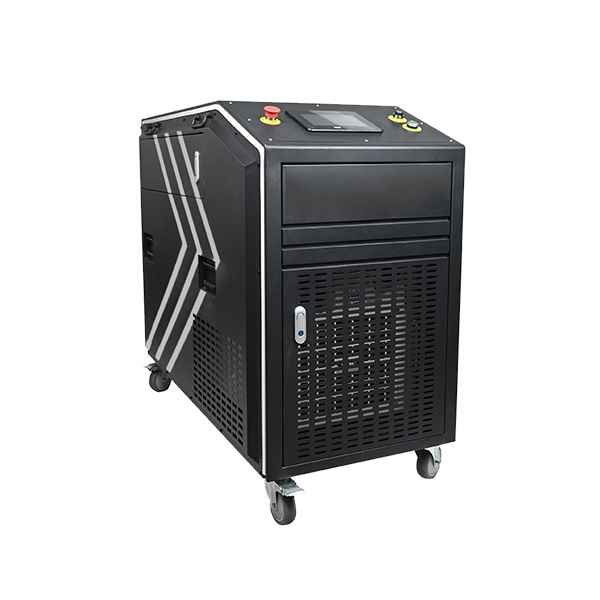
Model | Power | Factory Price | Ohter Price | Best For |
CHL-C1000 | 1000W | $5,500 – $7,500 | $5,000 – $8,000 | Light rust, general cleaning |
CHL-C1500 | 1500W | $5,500 – $7,500 | $5,000 – $8,000 | Most versatile, best seller |
CHL-C2000 | 2000W | $8,000 – $10,000 | $8,000 – $98,00 | Heavy rust, thick coatings |
CHL-C3000⭐ | 3000W | $10,000 – $13,000 | $10,000 – $12,000 | Shipyards, heavy industry |
Pulsed Laser Cleaners — Precision Without Damage
Pulsed lasers emit short, high-energy bursts for precision cleaning without heat damage.
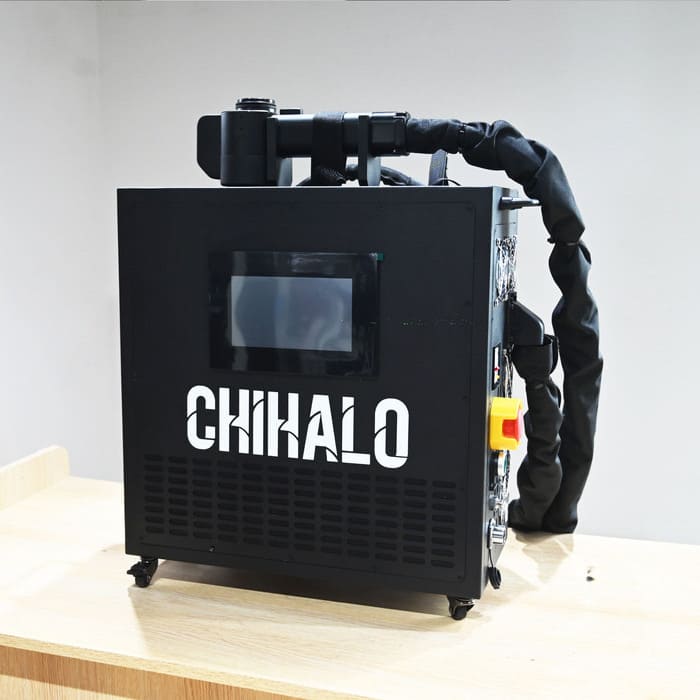
Model | Power | Factory Price | Dealer Price | Best For |
CHL-M100 | 100W | $5,000 – $7,000 | $8,000 – $12,000 | Small molds, electronics |
CHL-M200 | 200W | $7,000 – $98,00 | $12,000 – $18,000 | Injection molds, tire molds |
CHL-M300 | 300W | $9,000 – $12,000 | $18,000 – $28,000 | Aerospace, large molds |
CHL-M500 | 500W | $18,000 – $25,000 | $30,000 – $45,000 | High-volume precision work |
3-in-1 Machines (Clean + Weld + Cut)

Model | Power | Factory Price | Functions |
Multi-1500 | 1500W | $5,400 – $7,500 | Clean + Weld (3mm) + Cut (2mm) |
Multi-2000 | 2000W | $7,000 – $9,500 | Clean + Weld (4mm) + Cut (3mm) |
What Power Laser Cleaner Do You Need?
Most users: 1500W CW ($5,500-$7,500) for best balance.
Molds/precision: 200-300W Pulsed.
Heavy industrial: 2000W-3000W CW.
Thin metals under 2mm: always Pulsed to prevent warping.
Power Selection by Application
Application | Power | Type | Price Range |
Mold cleaning (injection/tire/rubber) | 200W – 300W | Pulsed | $7,000 – $15,000 |
Electronics / precision parts | 100W – 200W | Pulsed | $5,000 – $10,000 |
Thin metal sheets (<2mm) | 200W – 300W | Pulsed | $7,000 – $15,000 |
Light surface rust | 1000W – 1500W | CW | $3,500 – $6,500 |
Medium rust / paint removal | 1500W – 2000W | CW | $4,500 – $9,000 |
Heavy rust (>0.5mm) | 2000W – 3000W | CW | $6,000 – $14,000 |
Weld seam cleaning | 1000W – 1500W | CW | $3,500 – $6,500 |
Starting a cleaning business | 1500W – 2000W | CW | $4,500 – $9,000 |
Important: More power isn’t always better.
Using a 3000W CW laser on thin sheet metal will cause warping.
Match power to application.
What Is the Difference Between Pulsed and CW Laser Cleaners?
Short Answer: Pulsed lasers emit short bursts for precision work without heat damage (molds, thin metals). CW lasers emit constant beam for fast, high-volume rust/paint removal.
Pulsed costs 2-3x more but prevents substrate damage.
Choose pulsed for precision, CW for speed.
Factor | Pulsed Laser | Continuous Wave (CW) |
How it works | Short, high-energy bursts | Constant beam output |
Heat impact | Minimal (no buildup) | Higher (continuous energy) |
Cleaning speed | Moderate | Fast |
Best applications | Molds, thin metals, precision, restoration | Rust, paint, heavy contamination, large areas |
Substrate safety | Excellent | Good (risk on thin materials) |
Power range | 100W – 500W | 1000W – 3000W |
Price range | $3,000 – $25,000 | $5,000 – $13,000 |
MOPA 1000W Laser Cleaner
CW 2000W Laser Cleaner
Why Are Laser Cleaner Prices So Different?
Short Answer: The same machine can cost $5,000 factory-direct or $15,000 through dealers due to distribution markup layers, brand premiums, and support overhead.
Over 80% of “Western brand” laser cleaners use Chinese-made components—you’re often paying for the label, not different quality.
Price Markup Chain
- Factory cost(components + assembly + margin) = Base price
- Trading companyadds 15-30%
- Brand/importeradds 30-50%
- Dealeradds 20-40%
Total markup: 100-200% above factory price
Real Price Comparison: 1500W CW Laser Cleaner
Source | Price Range |
Factory direct (Chihalo) | $4,500 – $6,500 |
Chinese trading company | $6,000 – $8,000 |
US/EU branded (Chinese-made) | $9,000 – $15,000 |
European-manufactured | $15,000 – $25,000 |
The $9,000-$15,000 machines typically use identical Raycus/JPT laser sources to our $4,500-$6,500 machines.
How to Choose Your Laser Cleaner in 3 Steps?
Step 1 — What Are You Cleaning?
- Light surface rust on thick steel | 1000W-1500W CW | Fast, cost-effective |
- Heavy rust (you can feel the texture) | 2000W-3000W CW | Needs more power to penetrate |
- Paint or powder coating | 1500W-2000W CW | Coatings need more energy than rust |
- Injection molds or tire molds | 200W-300W Pulsed | Zero heat = no mold damage |
- Thin metal sheets (<2mm) | 200W Pulsed | CW would warp thin material |
- Weld seam cleaning | 1000W-1500W CW | Fast prep, no grinding needed |
Step 2 — Where Will You Use It?
Workshop/Fixed Location:
Standard cabinet or cart-mounted unit works fine.
Heavier = more stable = easier to use.
On-Site/Mobile Work:
Consider our portable units or backpack models.
Ask about our ruggedized carrying cases.
Production Line Integration:
We offer robot arm integration and automated fixtures.
Contact us for custom automation quotes.
Step 3 — Set Your Budget
Here’s what you can expect at each price point:
$3,000 – $5,000:
Entry-level 1000W CW
Good for: Hobbyists, small workshops, occasional use
Limitation: Slower on heavy rust
$5,000 – $8,000:
Mid-range 1500W-2000W CW ⭐ Best Value
Good for: Most industrial users, auto shops, fabricators
This is our most popular range for a reason.
$8,000 – $15,000:
Professional 2000W-3000W CW or 200W Pulsed
Good for: High-volume operations, precision work
Worth it if: Time is money, or you need zero heat impact
$15,000+:
High-power pulsed or automated systems
Good for: Aerospace, large-scale manufacturing
Custom configurations available.
Quick Checklist Before You Buy:
□ Identified your primary cleaning task
□ Decided between CW and Pulsed
□ Confirmed your power requirement
□ Checked voltage compatibility (we offer 110V/220V/380V options)
□ Asked about shipping to your country
Is It Safe to Buy a Laser Cleaner from China?
Short Answer: Yes, if you verify the manufacturer.
80%+ of laser cleaners worldwide use Chinese components (Raycus, JPT, MAX sources).
Key checks: certifications (CE, ISO), OEM experience, factory documentation, warranty terms. Certified manufacturers deliver identical quality at 30-40% lower prices.
The Truth About "Western" Laser Cleaners
Most laser cleaning machines sold under American and European brands contain:
- Raycuslaser sources (Chinese)
- JPTlaser sources (Chinese)
- MAX Photonicslaser sources (Chinese)
- WSXor Raytools optics (Chinese)
How to Verify Manufacturer Quality
- Request factory photos/video— Real manufacturers show production lines
- Ask for laser source documentation— Brand, model, serial number
- Ask about OEM experience— Suppliers to Western brands have proven standards
- Verify certifications— CE should be verifiable with issuing body
Can You Trust a Chinese Laser Manufacturer?
You’re thinking: “Chinese products are cheap for a reason, right?”
Here’s what most people don’t know:
Over 80% of laser cleaning machines sold worldwide—including those with
American and European labels—are manufactured in China. The laser sources
(Raycus, JPT, MAX Photonics) are Chinese. The scanning heads are Chinese.
The control systems are Chinese.
When you buy a “$15,000 German laser cleaner,” you’re often buying a
$6,000 Chinese machine with a $9,000 markup for the label and local warehouse.
We’re one of the factories those brands buy from.
Our verifiable credentials:
– National High-Tech Enterprise — This is a government
certification that fewer than 3% of Chinese manufacturers qualify for
– OEM supplier to 2 European laser brands (we can show you the export records)
– ISO 9001:2015 certified manufacturing process
– CE marking for EU market compliance
– Customers in 45+ countries including military and government contracts
How to verify we’re legitimate:
1. Request a video call factory tour (we’ll walk you through our production line)
2. Check our laser source serial numbers against Raycus/JPT databases
3. Read our Trustpilot reviews (we have 4.4 scores verified reviews)
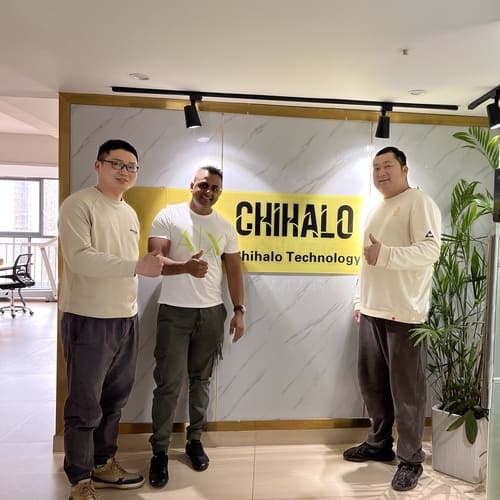
We’re not hiding behind a website. We’re a real factory with real people.


What Can a Laser Cleaner Machine Clean?
Short Answer: Laser cleaners remove rust, paint, oil, oxide layers, coatings, and mold residue from metals (steel, aluminum, copper), stone, concrete, and some plastics.
Most common uses: industrial rust removal, paint stripping, mold cleaning, and weld preparation.
1. Rust Removal — The Most Common Use
From surface oxidation to deep corrosion, laser cleaning handles it all.
Best for: Automotive parts, farm equipment, marine components, structural steel
Recommended: 1000W-2000W CW laser
Cleaning speed: 8-25 m²/hour depending on rust severity
Real result: A Texas auto shop replaced 6 hours of manual wire brushing
with 45 minutes of laser cleaning on a vintage truck frame.
2. Paint & Coating Stripping
Strips paint down to bare metal without chemicals or dust.
Best for: Automotive refinishing, aerospace rework, industrial repainting
Recommended: 1500W+ CW for thick coatings; 200W Pulsed for delicate parts
Cleaning speed: 5-15 m²/hour depending on coating thickness
Why it’s better: No chemical disposal costs. No respirator required.
No risk of warping thin panels (with pulsed laser).
3. Mold Cleaning — Where Pulsed Lasers Shine
Injection molds, tire molds, rubber molds—cleaned without removing from the machine.
Best for: Plastic injection shops, tire manufacturers, rubber molders
Recommended: 200W-300W Pulsed (CW would damage mold surfaces)
Cleaning time: 5-15 minutes per mold cavity
Industry insight: Laser cleaning is now standard in European automotive
mold shops. It reduces cleaning time by 70% vs. dry ice blasting.
4. Oil & Grease Removal
Best for: Engine rebuilders, precision machining, aerospace components
Recommended: 200W Pulsed for precision parts or 500W Pulse Laser for heavy oil
5. Heritage Restoration (Niche but Growing)
Best for: Stone monuments, historic metal artifacts, antique restoration
Recommended: Low-power Pulsed (50W-100W) for maximum control
Why laser: No water damage, no chemical residue, reversible process
Is Laser Cleaning Better Than Sandblasting?
Short Answer: Laser cleaning has higher upfront cost ($3,000-$45,000 vs $2,000-$10,000) but lower operating cost (no consumables vs $500-$2,000/year in media).
Laser wins on precision, substrate protection, and environment.
Sandblasting wins on initial cost and speed for very large surfaces.
Factor | Laser Cleaning | Sandblasting |
Equipment cost | $3,000 – $45,000 | $2,000 – $10,000 |
Annual consumables | ~$0 (lens: $100) | $500 – $2,000+ |
Substrate damage | None | Possible |
Precision | High | Low |
Environmental | Clean | Dust, waste |
Frequently Asked Questions
Laser cleaner machines cost between $3,000 and $45,000 depending on type and power level. Continuous Wave (CW) lasers range from $3,500-$13,000 for 1000W-3000W models, ideal for rust and paint removal. Pulsed lasers cost $5,000-$25,000 for 100W-500W, designed for precision work on molds and thin metals. Factory-direct pricing is typically 30-40% below dealer prices for identical specifications.
Pulsed lasers emit short, high-energy bursts (nanoseconds) with minimal heat transfer, making them ideal for cleaning molds, thin metals, and heat-sensitive surfaces without damage. CW (Continuous Wave) lasers provide constant beam output for faster cleaning speeds on heavy rust, paint, and thick coatings. Choose pulsed for precision and substrate protection; choose CW for speed and cost-effectiveness on thick metals.
For mold cleaning and precision work: 100-300W Pulsed. For light rust on thick steel: 1000-1500W CW. For heavy rust and thick coatings: 2000-3000W CW. For thin metals under 2mm: always use Pulsed to prevent warping. Most general industrial users find 1500W CW offers the best balance of speed, versatility, and cost at $5,500-$7,500.
No, when used correctly. Laser cleaning works through selective ablation: contaminants absorb laser energy and vaporize, while clean metal reflects the beam without damage. Pulsed lasers are safest for thin or heat-sensitive materials due to minimal thermal impact. CW lasers can cause warping on metals thinner than 2mm if power settings are too high. Always match laser type and power to material thickness.
Yes, from verified manufacturers. Over 80% of laser cleaners sold worldwide—including Western-branded units—use Chinese-made components (Raycus, JPT, MAX laser sources). Verify manufacturers by checking: National High-Tech Enterprise certification, CE/ISO certifications, OEM experience with Western brands, and factory documentation. Certified Chinese manufacturers deliver identical quality at 30-40% lower prices than dealer-marked units.
Laser cleaners effectively clean most metals including steel, stainless steel, aluminum, copper, and brass. They also work on stone, concrete, wood, and certain plastics. Common applications include removing rust, paint, oil, grease, oxide layers, coatings, weld discoloration, and mold residue. The 1064nm fiber laser wavelength is optimized for metal absorption, making it most effective on metallic surfaces.
Quality fiber laser sources from brands like Raycus, JPT, and MAX are rated for 100,000+ operating hours, translating to 10-15 years at typical industrial usage rates. Annual maintenance costs average $300-$500, primarily for protective lens replacement ($50-$100 every 6-12 months). Unlike chemical or abrasive cleaning, laser cleaners have no consumable media costs, making total cost of ownership significantly lower.
Yes, laser cleaning is a profitable service business with low barriers to entry. Initial investment ranges from $5,000-$20,000 for a quality machine. Typical service rates: $100-$300 per hour for rust removal and paint stripping. Common clients include auto restoration shops, marine services, industrial maintenance, and construction companies. Most operators achieve ROI within 6-12 months with proper local marketing.
Pulsed lasers cost 2-3x more than CW due to sophisticated technology required for generating high-peak-power pulses. A 300W pulsed laser achieves 15kW peak power through Q-switching technology, requiring precision timing circuits, specialized optics, and advanced cooling systems. This complexity enables heat-free cleaning essential for molds, thin metals, and delicate restoration work where CW lasers would cause damage.
Essential safety equipment includes: OD5+ laser safety glasses rated for 1064nm wavelength (usually included with machine), fume extraction system for removing vaporized contaminants, work area signage warning of Class 4 laser operation, and standard PPE. Class 4 lasers require controlled access during operation—no unauthorized personnel in the beam path. Reputable manufacturers provide safety training documentation with every purchase.
Ready to Get Your Laser Cleaner?
What happens after you contact us:
1. We ask about your cleaning application (5 minutes)
2. We recommend a specific model with pricing (24 hours)
3. You can request a video demonstration of your use case
4. If you proceed, we offer video inspection before shipping
5. Your machine ships with tracking + all customs documentation
Three ways to move forward:
Option 1: Get a Price Quote
Tell us what you need to clean, and we’ll recommend the right machine
with exact pricing—usually within 24 hours.
Option 2: See It Work on YOUR Material
Not sure if laser cleaning will work for your application?
Ship us a sample (or send photos), and we’ll run a test cleaning.
Video proof included.
Option 3: Talk to a Human
Got questions? Our engineers are available
Monday-Saturday, 9am-6pm China time.
WhatsApp: +86 18608325040 (fastest response)
Email: info@chihalo.com