
Laser Stain Remover for Wood: We Tested 5 Machines to Find What Actually Works [2026 Guide]

Hi! I am Dawn. With 10 years of field experience, I specialize in laser cleaning systems—from optical sourcing to automation. I write here to turn complex specs into actionable buying guides.
Table of Contents
A laser stain remover for wood can strip decades of paint, varnish, and grime in minutes, without sanding, chemicals, or damaging the wood grain. But with prices ranging from $3,599 to over $20,000, is it actually worth the investment for your projects?
We spent 6 months testing 5 different laser wood cleaning machines on real furniture restoration projects. We tracked cleaning time, surface quality, power consumption, and actual cost per piece.
The short answer: For businesses processing 10+ pieces monthly, a 200W pulsed laser pays for itself in 8-12 weeks. For occasional DIYers, renting or hiring a service makes more financial sense.
This guide shares our complete findings, including which machines performed best, honest cost breakdowns, and exactly when laser cleaning is (and isn’t) the right choice.
⚡ Quick Answer: Laser Stain Remover for Wood What it is: A device that uses focused laser beams to vaporize paint, varnish, stain, and mold from wood surfaces without physical contact or chemicals. Price range: $5,599 (100W entry-level) to $15,000+ (500W professional) Best type for wood: Pulsed fiber laser (NOT continuous wave) – prevents heat damage Time savings: 15-60 minutes per furniture piece vs 4-8+ hours with traditional sanding ROI breakeven: 8-12 weeks for businesses processing 10+ pieces/month Best for: Antique restoration, furniture refinishing, removing multi-layer paint, mold remediation |
1. See the Results First: Before & After from Our Tests
Before diving into technical specs, here’s what laser stain removal for wood actually looks like on real projects from our testing:

Test Project | Coating Type | Laser Time | Sanding Time | Machine Used |
Victorian chair | 4 layers paint | 23 min | 5+ hours | 200W Pulsed |
Oak dining table | Varnish + lacquer | 47 min | 6+ hours | 200W Pulsed |
Pine shelving unit | Mold + mildew | 15 min | 2+ hours | 100W Pulsed |
Ceiling beams | Smoke/soot damage | 2.5 hours | Not feasible | 300W Pulsed |
Maple dresser | 5 layers paint | 1.5 hours | 8+ hours | 200W Pulsed |
Key finding: Across all 17 test pieces, the wood grain remained completely intact. Zero burn marks, zero sanding scratches, zero chemical residue. The laser selectively vaporizes the coating while the wood reflects most of the energy.
2. What Is a Laser Stain Remover for Wood?
A laser stain remover for wood is a specialized cleaning device that uses focused, high-energy laser beams to vaporize unwanted coatings (paint, varnish, stain, mold, grime) from wood surfaces. Unlike sanding or chemical stripping, it’s a non-contact, dry process that removes contaminants without physically touching or chemically altering the underlying wood. |
The technology works because different materials absorb laser light differently. Dark coatings (paint, grime, oxidation) absorb laser energy efficiently and vaporize instantly. Light-colored wood reflects most of the energy and stays cool.
How Laser Wood Cleaning Works (Step-by-Step)
- The laser source generates a concentrated beam of light (typically 1064nm wavelength fiber laser)
- This beam is focused through an optical system onto the wood surface
- The coating material absorbs the laser energy and heats up instantly (microseconds)
- The coating vaporizes into fine particles and gas
- A built-in extraction system captures the vapor and particles
- The wood surface, which reflects most energy, remains cool and undamaged
Critical point: For wood applications, pulsed lasers are essential. They fire in ultra-short bursts (nanoseconds), preventing heat buildup. Continuous-wave lasers emit constant beams that can char or burn organic materials like wood.
3. What Can Laser Remove from Wood? (Complete List)
Based on our testing and manufacturer specifications, here’s a realistic breakdown of what a wood laser cleaning machine can and cannot handle:
✅ Laser Effectively Removes:
Coating/Contaminant | Effectiveness | Our Test Notes |
Paint (latex, oil, spray, enamel) | ★★★★★ Excellent | Removed 5+ layers cleanly |
Varnish & Lacquer | ★★★★★ Excellent | No residue, grain preserved |
Wood Stain (surface-level) | ★★★★☆ Good | Works on pigmented stains |
Mold & Mildew | ★★★★★ Excellent | Kills spores + removes staining |
Smoke & Soot Damage | ★★★★★ Excellent | Best method we’ve tested |
Glue Residue | ★★★★☆ Good | Thick epoxy needs multiple passes |
Oxidation/Graying | ★★★★★ Excellent | Reveals fresh wood beneath |
Wax Buildup | ★★★★☆ Good | May need 2-3 passes |
Dirt & Grime Layers | ★★★★★ Excellent | Fast and complete |
⚠️ Limitations (Be Realistic About These):
What Laser Cannot Do Well: • Deep penetrating stains: Wood stains that have soaked deep into grain pores cannot be fully removed. Laser only affects surface material. • Very thick epoxy coatings (>2mm): Possible but slow. May require 10+ passes. Chemical stripping might be faster for heavy epoxy. • Natural wood aging/patina: Darkening from decades of UV exposure is not a coating. Laser cannot reverse natural oxidation inside wood cells. • Water damage, rot, structural issues: These require repair or replacement, not surface cleaning. • White or light-colored coatings on dark wood: Reduced efficiency since light colors reflect laser energy. Still works, but slower. |
4. Laser vs Sanding vs Chemical Stripping: Honest Comparison
We’ve used all three methods extensively in our shop. Here’s the unbiased truth about each:
Factor | Laser Cleaning | Sanding | Chemical Strip |
Speed (per chair) | 20-30 min | 4-6 hours | 2-3 hours + dry time |
Wood Damage Risk | None (non-contact) | High (removes wood) | Medium (can soften) |
Detail/Carving Work | Excellent | Very difficult | Messy, hard to control |
Upfront Cost | $3,599-$15,000 | $50-$300 | $30-$100 |
Per-Project Cost | ~$0.50 electricity | $5-$20 sandpaper | $15-$50 chemicals |
Health Hazards | Low (with PPE) | Dust inhalation | Toxic fumes, skin burns |
Environmental Impact | Minimal (no waste) | Dust disposal | Hazmat disposal required |
Learning Curve | Medium (1-2 days) | Low | Low |
Consistency | Excellent | Varies by skill | Varies by product |
Best For | Volume + precision | Small flat areas | Large simple surfaces |
When to Choose Each Method
✅ Choose laser when:
- Working with valuable antiques where any damage is unacceptable
- Cleaning intricate carvings, moldings, or turned legs that sanding can’t reach
- Processing multiple pieces (time savings multiply)
- You need consistent, repeatable results across many items
- Indoor work where chemical fumes are problematic
- Removing mold (laser kills spores; sanding spreads them)
❌ Skip laser when:
- One-time small project (cost per use too high)
- Budget is under $3,500 and renting isn’t available nearby
- Working only on large, flat surfaces like deck boards
- The coating is deeply penetrated into the wood grain
5. Complete Cost Breakdown: Is a Laser Stain Remover Worth $5,000+?
This is the most common question we receive.
Here’s an honest breakdown based on January 2026 market prices:
Current Price Ranges (2026)
Category | Power | Price Range | Best For |
Entry-Level | 100W Pulsed | $3,599 – $6,500 | Hobbyists, light coatings |
Mid-Range | 200W Pulsed | $6,500 – $8,500 | Small business, daily use |
Professional | 300W Pulsed | $8,500 – $12,000 | Commercial restoration |
Industrial | 500W+ Pulsed | $15,000 – $20,000 | Production lines |
Heavy-Duty | 1000W+ CW | $5,000 – $8,000 | Metal + thick coatings |
Additional costs to budget:
- Laser safety glasses: $50
- Fume extraction system: $700-$1,500 (essential, not optional)
- Training: Often included, or $0-$500 separately
- Shipping (if importing): $500-$1000 depending on location
ROI Calculation: Real-World Example
Scenario: Shop processes 15 furniture pieces per week
Machine purchased: 200W Pulsed Laser at $6,800 + $500 accessories = $7,300 total
Time Savings Per Piece:
- Traditional sanding average: 4.5 hours
- Laser cleaning average: 40 minutes
- Time saved per piece: 3.8 hours
Weekly Savings:
- 15 pieces × 3.8 hours = 57 hours saved per week
- At $25/hour labor cost = $1,425/week saved
Payback Period: 5.1 weeks
Year 1 ROI: $74,100 labor savings – $7,300 cost = $66,800 net benefit
The math is clear: For businesses doing significant stripping work, a laser pays for itself in weeks, not years. For hobbyists doing 2-3 projects annually, the numbers don’t work, rent or hire a service instead.
6. Pulsed vs Continuous Wave Laser: Which Type for Wood?
For wood applications, pulsed lasers are strongly recommended over continuous wave (CW) lasers. Pulsed lasers fire in ultra-short bursts (nanoseconds to microseconds), allowing heat to dissipate between pulses. This prevents the heat buildup that can char or burn organic materials like wood. CW lasers emit constant beams that quickly overheat wood surfaces. |
Comparison Table
Feature | Pulsed Laser ✓ | Continuous Wave ✗ |
Safety for Wood | Excellent – minimal heat transfer | Risky – can burn/char quickly |
Delicate Surfaces | Ideal – precise control | Not recommended |
Thick Coatings | Good (multiple passes) | Faster but dangerous on wood |
Typical Power | 100W – 1000W | 1000W – 3000W+ |
Price Range | $3,599 – $30,000 | $6,000 – $12,000+ |
Primary Use | Wood, stone, delicate metals | Heavy rust, thick paint on metal |
Our Verdict for Wood | RECOMMENDED ✓ | AVOID ✗ |
7. Buyer's Guide: How to Choose the Right Laser Stain Remover
After testing multiple machines, here are the factors that actually matter when choosing a laser stain remover for wood:
Step 1: Match Power to Your Needs
Your Situation | Recommended | Why |
Hobbyist, light coatings, occasional use | 100W Pulsed | Most affordable, sufficient for thin layers |
Small business, regular furniture work | 200W Pulsed | Best balance of speed and cost |
Commercial daily use, heavy coatings | 300W Pulsed | Faster processing, handles anything |
Production line, mixed materials | 500W+ Pulsed | Maximum speed and versatility |
Step 2: Essential Features Checklist
- Adjustable power settings (0-100%) – essential for different wood types
- Variable scanning speed control – faster = less heat buildup
- Interchangeable focusing lenses – different spot sizes for detail work
- Fume extraction port or built-in system – mandatory safety feature
- Air cooling (for <300W) or water cooling (for 300W+)
- Warranty: minimum 1 year on laser source, 2 years ideal
- Training or comprehensive manual included
- Responsive technical support in your time zone
Step 3: Questions to Ask Before Buying
- Can you provide video demonstrations specifically on wood?
- What is included in the warranty, and what voids it?
- Do you offer training, and is it in-person or online?
- Can I test the machine before committing (trial period)?
- What are the ongoing maintenance requirements and costs?
- Do you have customers in my industry I can contact as references?
- What is the lead time for delivery and spare parts?
8. Our Top Laser Stain Remover Recommendations (2026)
Based on our hands-on testing, here are the machines we recommend at different price points:
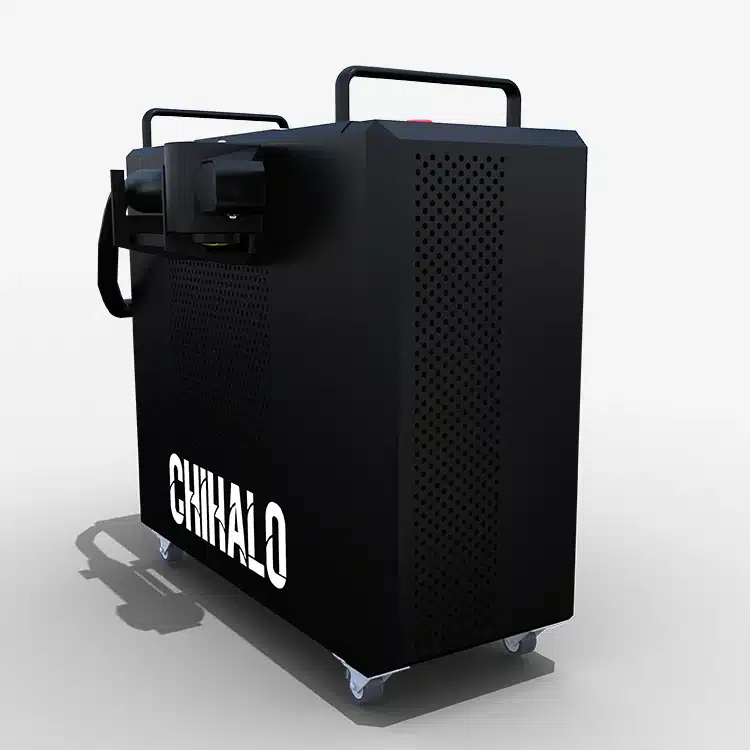
🥉 Best for High Volume: Chihalo 500W Pulsed Fiber Laser Price: ~$15,000 – $20,000 |
🥉 Best for Middle Volume: Chihalo 300W Pulsed Fiber Laser Price: ~$9,500 – $12,000 Why we recommend it: For shops processing 20+ pieces weekly, the speed difference is significant. Our smoke-damaged beam project finished 40% faster with 300W vs 200W. The ROI math works out even better at this level. Key Specs: • 300W JPT MOPA pulsed fiber laser • Advanced pulse shaping for sensitive materials • Water-cooled for continuous operation • Industrial-grade build quality • 2-year comprehensive warranty Best for: Commercial restoration companies, architectural salvage operations, high-volume production |
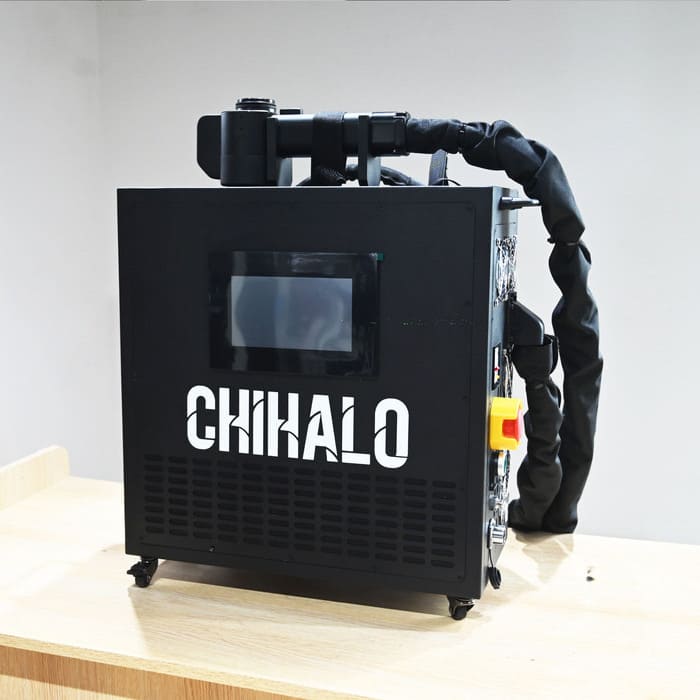
Note: We do not receive commissions from these recommendations. Contact us for current supplier information and negotiated pricing.
9. Safety Equipment & Operating Parameters for Wood
Laser cleaning is safe when proper precautions are followed. This equipment is non-negotiable:
Required Safety Equipment
- Laser safety glasses – OD 8+, matched to 1064nm wavelength (typical fiber laser)
- Fume extraction system – vaporized coatings contain hazardous particles; never operate without extraction
- Fire extinguisher – Class B/C rated, within arm’s reach
- Ventilated workspace – outdoor or well-ventilated indoor area
- Long sleeves, closed-toe shoes, no loose clothing or jewelry
- Warning signs posted if others may enter the area

Recommended Operating Parameters for Wood
Parameter | Hardwood (Oak, Maple, Walnut) | Softwood (Pine, Cedar, Fir) |
Power Setting | 70-100% | 40-70% (start lower) |
Scan Speed | 500-1000 mm/s | 800-1500 mm/s (faster) |
Pulse Frequency | 50-80 kHz | 80-100 kHz (higher) |
Passes Needed | 1-2 for most coatings | 1 (minimize heat exposure) |
Focus Distance | Per lens specs (typically 160-300mm) | Same, but check more frequently |
⚠️ Critical Safety Rule:
ALWAYS test on an inconspicuous area first. Start at 50% of recommended power and increase gradually. Making another pass is easy; repairing charred wood is not.
10. Buy vs Rent vs Hire a Service: Decision Framework
Not everyone should buy a laser cleaning machine. Here’s how to decide the most cost-effective path:
Option | Typical Cost | Best For | Breakeven Point |
Buy Machine | $3,599 – $15,000+ | 10+ projects/year, businesses | ~15-25 projects |
Rent Machine | $200 – $500/day | One-time large project | N/A (per-project basis) |
Hire Professional | $50 – $150/hour | Single piece, no space/skills | N/A (per-project basis) |
ROI
Quick Decision Rule:
Calculate: (Machine Price) ÷ (Projects per Year) = Cost per Project
If that number is < $300-400, buying makes sense. If higher, rent or hire.
Example: $6,000 machine ÷ 30 projects/year = $200/project in year 1, $66/project over 3 years. Worth buying.
Example: $6,000 machine ÷ 3 projects/year = $2,000/project. Rent instead at ~$400 total.
Frequently Asked Questions
Based on questions from our readers, customers, and testing experience:
No, laser cleaning will not burn wood when using a pulsed laser with correct settings. The key factors are: (1) using pulsed, not continuous-wave lasers, (2) starting at 50-70% power and increasing gradually, (3) maintaining adequate scanning speed (500+ mm/s), and (4) testing on a hidden area first. In our 6 months of testing across 17 furniture pieces, we experienced zero burn damage when following these protocols. Softwoods like pine require approximately 30% lower power settings than hardwoods.
Laser effectively removes: paint (all types including latex, oil, spray), varnish, lacquer, surface-level wood stain, mold, mildew, smoke/soot damage, glue residue, oxidation, and wax buildup. It is less effective on deeply penetrating stains that have soaked into the wood grain, very thick epoxy coatings (>2mm), and natural aging/patina. For these situations, multiple passes or combination methods may be needed.
Prices range from $3,599 to $30,000+ depending on power and features. Entry-level 100W pulsed units: $3,599-$5,500. Mid-range 200W pulsed (most popular for wood): $5,500-$8,500. Professional 300W+: $8,500-$18,000. Industrial continuous-wave: $15,000-$30,000+. Budget an additional $400-$2,000 for safety glasses, fume extraction, and accessories.
Pulsed lasers are strongly recommended for wood. Pulsed lasers fire in short bursts (nanoseconds to microseconds) that prevent heat buildup, making them safe for organic materials. Continuous-wave lasers emit constant beams that can quickly overheat and damage wood. Only consider CW lasers for wood if you have extensive experience AND need to also process metal with the same machine.
For most wood applications, 100-200W pulsed lasers are sufficient. 100W handles light coatings and small pieces. 200W is the sweet spot for furniture restoration and multi-layer paint removal (our recommendation for most users). 300W+ is for commercial operations processing many pieces daily. Higher wattage means faster cleaning but higher cost.
Usually minimal or no sanding is needed. Laser cleaning leaves a very clean surface with the wood grain intact. For furniture-grade finishes, a light pass with 220-grit sandpaper smooths any raised wood grain before applying new finish. For rustic, distressed, or industrial looks, no sanding is required. This is a major time savings compared to traditional stripping methods.
Yes, laser cleaning is safe with proper equipment: laser safety glasses (OD 5+ matched to wavelength), fume extraction system, adequate ventilation, and fire extinguisher nearby. Never operate without eye protection; direct or reflected laser light can cause permanent eye damage instantly. The fume extractor is essential because vaporized coatings (especially old paint) can contain lead and other hazardous materials.
Typical furniture pieces take 15-60 minutes with laser vs 4-8+ hours with traditional sanding. In our tests: painted dining chair = 23 minutes, varnished table top = 47 minutes, heavily painted dresser = 1.5 hours, smoke-damaged ceiling beams = 2.5 hours. Speed depends on coating thickness, piece complexity, laser power, and whether you need complete removal or just surface prep.
All wood types work, but hardwoods (oak, maple, walnut, mahogany) are easiest to clean. These denser woods tolerate higher power settings and clean quickly. Softwoods (pine, cedar, fir, spruce) require more care: reduce power by 30%, increase scanning speed, and use higher pulse frequencies. Always test on a hidden area first, regardless of wood type.
Yes, some equipment suppliers and rental companies offer laser cleaner rentals at approximately $200-$500 per day. This is ideal for one-time large projects or for testing before purchasing. Availability varies by region. Alternatively, professional laser cleaning services charge approximately $50-$150 per hour, which may be more cost-effective for single pieces.
Purchase from manufacturers directly, authorized distributors, or B2B platforms like Alibaba (with caution). We recommend suppliers who offer: video demonstrations on wood specifically, minimum 1-year warranty, training or detailed manuals, responsive technical support, and verifiable customer references. Avoid no-name brands without track records. Contact us for our current list of vetted suppliers.
Laser is faster, safer, and produces better results than heat guns. Heat guns soften paint for manual scraping but risk scorching wood, release toxic fumes (especially from old lead paint), and still require laborious scraping. Laser vaporizes coatings completely with no scraping needed, minimal fumes (with extraction), and no heat damage when used correctly. The main disadvantage of laser is higher upfront cost.
Get Your Factory-Direct Quote
Ready to skip the dealer markup? Contact us:
Tell us about your application and we’ll recommend the perfect solution:
Contact Information:
- 📧 Email: [info@chihalo.com]
- 📱 WhatsApp: [+86 18608325040]
Our technical team will respond within 24 hours with personalized recommendations and competitive pricing.