
Best Laser Rust Removal Gun 2025: Complete Buyer's Guide
Dawn Huang
I'm a passionate engineer and the founder of Chihalo Laser Factory. With an M.Sc. from HKU and 10 years in the field, I've mastered the laser craft from the ground up — from selecting parts to automating systems. Here, I translate complex industry updates into actionable knowledge. Join our community to stay ahead!
Table of Contents
Key Takeaways
- Price Range: $5,800 – $16,800 for CW 1000W – 3000W laser cleaner; $3,000 – $70,000 for pulsed 20W to 1000W laser cleaning machines
- Best Power for Most Users: CW 2000W-3000W or MOPA 200W-500W handles 90% of industrial rust removal jobs
- ROI Timeline: Most businesses recover investment within 12-18 months
- Key Advantage: Zero consumables, eco-friendly, removes rust without damaging metal
- Best Industries: Automotive repair, shipbuilding, manufacturing, restoration and more
What Is a Laser Rust Removal Gun?
Definition: A laser rust removal gun is a handheld fiber laser device that uses high-intensity laser beams to vaporize rust, paint, oxide layers, and other surface contaminants from metal through a process called laser ablation—without damaging the underlying material. Prices range from $3,800 to $16,800 depending on power level.
Unlike traditional rust removal methods that rely on chemicals, abrasives, or physical scraping, laser cleaning is a non-contact process. The laser beam targets only the contaminant layer while leaving the base metal completely intact. This makes it the preferred choice for precision applications where surface integrity matters.
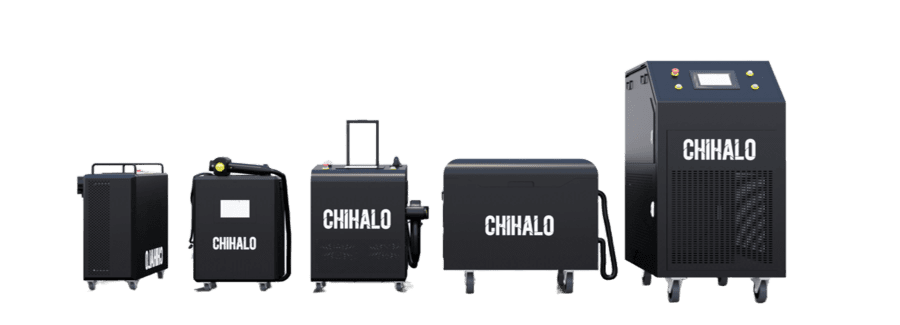
A complete laser rust removal system consists of three core components:
Fiber Laser Source: The power source that produces the laser beam. Power options typically range from 20W for light-duty work to 6000W for heavy industrial applications. Leading brands include JPT, Raycus, MAX, and IPG.
Handheld Laser Cleaning Gun: The operator-controlled device that directs the laser beam onto the surface. It contains a galvanometer scanner that shapes and distributes the laser beam in precise patterns. Most cleaning guns weigh between 600g and 900g for comfortable extended use.
Chassis of the Machine: Every factory has its own designed chassis, from backpack, portable, enclosed to automatic chassis.
They have different looking, weight and size, cooling designs and metal materials.
CW Laser vs Pulsed Laser: Which Type Is Better?
There are two main types of laser rust removal guns, and choosing the right one depends on your specific application:
Feature | CW (Continuous Wave) Laser | Pulsed Laser |
How It Works | Emits continuous laser beam | Emits short, high-energy pulses |
Power Range | 1000W – 6000W | 100W – 500W |
Price Range | $5,800 – $16,800 | $3,000 – $7,000 |
Best For | Heavy rust, thick coatings, industrial cleaning | Delicate surfaces, precision work, conservation |
Cleaning Speed | Faster | Slower |
Substrate Protection | Good | Excellent |
Recommended Users | Automotive, shipbuilding, manufacturing | Aerospace, cultural heritage, electronics |
Our Recommendation: For 90% of commercial and industrial users, CW lasers offer the best balance of performance, speed, and value. Pulsed lasers are worth the premium only when working with extremely delicate materials or high-value items where zero substrate damage is critical.
How Much Does a Laser Rust Removal Gun Cost?
2025 Pricing: Laser rust removal guns cost between $3,800 and $16,800 for CW (Continuous Wave) models. Entry-level 1000W units start at $3,800, mid-range 2000W models cost $6,500-$8,800, and professional 6000W machines reach $12,000-$16,800. Pulsed laser systems for precision work range from $10,000 to $90,000.
2025 Price Breakdown by Power Level
Power Level | Price Range (USD) | Best For | Cleaning Efficiency |
1000W | $3,800 – $4,800 | Light rust, small parts, hobbyists | 5-8 m²/hour |
1500W | $4,500 – $5,500 | Medium rust, small workshops | 8-12 m²/hour |
2000W | $6,500 – $8,800 | Industrial standard, automotive | 12-18 m²/hour |
3000W | $9,000 – $12,000 | Heavy rust, shipbuilding, large equipment | 18-30 m²/hour |
6000W | $12,000 – $16,800 | Maximum productivity, production lines | 50-90 m²/hour |
Prices based on manufacturer quotes collected November 2025. Actual prices may vary based on supplier, location, and included accessories.
Factors That Affect Pricing
Several factors influence the final cost of a laser rust removal gun:
- Laser Source Brand
- Raycus: Most affordable, reliable quality, widely available parts
- MAX: Mid-range pricing, excellent performance-to-cost ratio
- IPG: Premium pricing, highest beam quality, longest lifespan
- Cleaning Gun
- Most of suppliers would buy laser cleaning gun and software from ZBTK, SUP or other galvanometer factories. They are basicly looks the same and provide 1 year of warranty.
- Chihalo has its own designed cleaning gun and provide 2 years of warranty.
- Included Features
- Basic models: Manual focus, simple controls, touchscreen interface, multiple cleaning modes
- Advanced models: Auto-focus(Chihalo), Dual Touch screen(Chihalo), mobile app control
- Warranty and Support
- Standard: 1-year machine warranty, 2-year laser source warranty
- Extended: 3-year comprehensive coverage adds $500-$1,500
- Chihalo: Standard warranty is 2 years for every parts including shipping cost.
- Shipping and Import Costs
- Sea freight: $300-$800 (15-30 days)
- Air freight: $1,000-$2,500 (7-10 days)
- Import duties vary by country (typically 0-15%)
ROI Analysis: Is It Worth the Investment?
Short Answer: Yes, for most commercial users. The typical payback period is 12-18 months, with significant long-term savings compared to traditional methods.
Let’s break down the numbers for a typical automotive restoration shop:
Investment Scenario: 2000W Laser Rust Removal Gun
Item | Cost |
Equipment Cost | $8,000 |
Shipping | $500 |
Safety Equipment | $300 |
Total Initial Investment | $8,800 |
Revenue Potential
Metric | Value |
Service rate (laser rust removal) | $100-$200/hour |
Average working hours per day | 4 hours |
Working days per month | 20 days |
Monthly Revenue Potential | $8,000 – $16,000 |
Operating Cost Comparison (Annual)
Method | Consumables | Labor Hours | Waste Disposal | Total Annual Cost |
Laser Cleaning | $0 | 800 hrs | $0 | $200 (electricity) |
Sandblasting | $6,000 | 1,600 hrs | $2,000 | $8,000+ |
Chemical Treatment | $4,000 | 1,200 hrs | $3,000 | $7,000+ |
Break-Even Analysis: At just 2 paid jobs per week ($400-$800/week), most businesses recover their investment within 3-6 months. For high-volume operations, ROI can be achieved in as little as 4-8 weeks.
Power Guide: Which Wattage Do You Need?
Quick Guide: Choose 1000W-1500W for occasional light-duty work, 2000W-3000W for regular industrial use (recommended for most buyers), and 6000W only for high-volume production environments.
Selecting the right power level is the most important decision when buying a laser rust removal gun. Too little power means slow cleaning and inability to handle heavy rust. Too much power wastes money on capabilities you don’t need.
1000W - 1500W: Light-Duty Applications
Best For:
- Thin rust layers and light oxidation
- Small parts and components
- Hobby use and small workshops
- Jewelry, coins, and collectibles
- Occasional rust removal needs
Typical Users:
- Small auto repair shops
- Antique restoration hobbyists
- Maintenance technicians
- Small manufacturing facilities
Limitations:
- Struggles with heavy, multi-layer rust
- Slower processing of large surface areas
- May require multiple passes on thick coatings
Our Verdict: Great entry point for businesses testing laser cleaning or those with genuinely light-duty needs. However, most commercial users outgrow 1000W capacity within 6-12 months.
2000W - 3000W: Industrial Standard (Recommended)
Best For:
- Medium to heavy rust removal
- Automotive frames, chassis, and body panels
- Industrial equipment maintenance
- Marine and shipbuilding applications
- Paint stripping and coating removal
- Pre-welding and post-welding treatment
Typical Users:
- Professional auto restoration shops
- Manufacturing facilities
- Shipyards and marine maintenance companies
- Steel fabrication shops
- Industrial cleaning service providers
Advantages:
- Handles 90% of industrial rust removal jobs
- Optimal balance of speed and cost
- Can process 15-30 m² per hour
- Sufficient power for most commercial applications
Our Verdict: The 2000W-3000W range represents the sweet spot for most commercial and industrial buyers. We recommend starting here unless you have very specific light-duty or heavy-duty requirements.
6000W: Heavy-Duty Professional Use
Best For:
- Extremely heavy, deeply embedded rust
- Large-scale industrial cleaning
- Production line integration
- Maximum throughput requirements
- Thick, multi-layer coating removal
Typical Users:
- Large manufacturing plants
- Shipbuilding and offshore facilities
- Steel mills and foundries
- Heavy equipment manufacturers
- Commercial cleaning service companies
Considerations:
- Requires 380V three-phase power supply
- Higher equipment weight (240kg+)
- Larger footprint
- Higher initial investment
Our Verdict: Only recommended for operations that genuinely need maximum productivity. For most users, a 3000W unit handles heavy rust at lower cost.
Laser Rust Removal vs Other Methods: Complete Comparison
Summary: Laser rust removal offers superior precision, zero consumables, and environmental friendliness, but has higher upfront cost. For most commercial operations processing more than 20 m² monthly, laser becomes more economical within 12-18 months.
When evaluating rust removal options, consider not just the initial cost but the total cost of ownership, including consumables, labor, environmental compliance, and surface quality.
Laser vs Sandblasting
Factor | Laser Rust Removal | Sandblasting |
Initial Cost | $3,800 – $16,800 | $500 – $3,000 |
Consumables | None | $500-$1,000/month |
Surface Damage Risk | None | Medium-High |
Precision | Excellent (selective cleaning) | Poor (blanket coverage) |
Cleanup Required | Minimal | Extensive |
Environmental Impact | Low (no waste) | High (dust, disposal) |
Noise Level | Low (60-70 dB) | High (100+ dB) |
PPE Requirements | Safety glasses | Full suit, respirator, hearing protection |
Indoor Use | Yes | Limited |
Substrate Types | All metals | Most surfaces |
When to Choose Sandblasting: Large outdoor surfaces where precision doesn’t matter and disposal is easy. Budget-constrained one-time projects.
When to Choose Laser: Precision work, indoor applications, regular use, environmental compliance requirements, or when preserving substrate integrity is important.
Laser vs Chemical Rust Removers
Factor | Laser Rust Removal | Chemical Treatment |
Initial Cost | $3,800 – $16,800 | $50 – $500 |
Consumables | None | $200-$500/month |
Processing Time | Minutes | Hours to days |
Surface Damage Risk | None | Medium (acid damage) |
Environmental Impact | Low | High (hazardous waste) |
Worker Safety | Glasses only | Extensive chemical PPE |
Disposal Requirements | None | Regulated hazmat disposal |
Effectiveness on Heavy Rust | Excellent | Good |
Geometric Limitations | None | Dipping/soaking required |
When to Choose Chemical: Small parts that can be fully submerged, extremely tight budgets, or locations without power access.
When to Choose Laser: Anything that can’t be submerged, when environmental compliance matters, or for regular ongoing rust removal needs.
5-Year Total Cost Comparison
Assuming 100 m² of rust removal per month:
Cost Category | Laser (2000W) | Sandblasting | Chemical | Manual |
Equipment | $8,000 | $2,000 | $200 | $300 |
Consumables (5 yr) | $0 | $30,000 | $15,000 | $9,000 |
Labor (5 yr) | $40,000 | $80,000 | $60,000 | $120,000 |
Disposal (5 yr) | $0 | $10,000 | $15,000 | $1,000 |
5-Year Total | $48,000 | $122,000 | $90,200 | $130,300 |
Cost per m² | $8.00 | $20.33 | $15.03 | $21.72 |
Calculations based on average labor rates of $25/hour and typical processing times for each method.
Applications: Industries and Use Cases
Laser rust removal guns are transforming maintenance and restoration across multiple industries. Here are the most common applications with real-world examples.
Automotive and Restoration
Common Applications:
- Frame and chassis rust removal
- Body panel preparation for repainting
- Engine component cleaning
- Brake caliper and suspension part restoration
- Classic car restoration
Why Laser Works Best: Automotive restoration requires removing rust without thinning the metal or creating surface irregularities that show through paint. Laser cleaning removes only the rust layer, preserving the original metal thickness and profile.
Case Study: A classic car restoration shop in California switched from sandblasting to a 2000W laser system. Results after one year:
- Processing time reduced by 65%
- Paint adhesion improved (fewer repaints needed)
- No substrate damage on thin vintage panels
- Eliminated sand cleanup and disposal costs
Shipbuilding and Marine Maintenance
Common Applications:
- Hull rust removal
- Deck surface preparation
- Ballast tank maintenance
- Anchor chain and equipment cleaning
- Weld preparation and post-weld cleanup
Why Laser Works Best: Marine environments create aggressive corrosion that requires frequent maintenance. Laser cleaning can be done in confined spaces without generating hazardous dust, and the portable units can reach areas sandblasting equipment cannot.
Typical Setup: Shipyards often deploy 3000W-6000W units for maximum productivity on large surface areas.
Manufacturing and Industrial Maintenance
Common Applications:
- Mold cleaning (tire molds, injection molds)
- Production equipment maintenance
- Conveyor system cleaning
- Welding preparation and cleanup
- Tool and die maintenance
Why Laser Works Best: Manufacturing cannot tolerate the downtime or contamination risk of traditional cleaning methods. Laser cleaning leaves no residue that could affect product quality.
Efficiency Gain: A tire manufacturer reported 80% reduction in mold cleaning time after implementing laser cleaning, with zero mold damage compared to previous dry ice blasting method.
Cultural Heritage and Conservation
Common Applications:
- Ancient metal artifact restoration
- Architectural bronze and copper cleaning
- Historical machinery preservation
- Museum piece conservation
- Monument and sculpture cleaning
Why Laser Works Best: Conservation demands absolute precision with zero damage to original materials. Pulsed lasers can remove centuries of corrosion layer by layer, preserving patina where desired while removing harmful oxidation.
Recommended Equipment: Low-power pulsed lasers (100W-300W) with precise power control for conservation work.
Pre-Welding and Post-Welding Treatment
Common Applications:
- Removing mill scale before welding
- Cleaning weld preparation zones
- Post-weld oxide and discoloration removal
- Surface activation for improved weld penetration
Why Laser Works Best: Oxides, oils, and contaminants on metal surfaces cause weld porosity and reduce joint strength. Laser cleaning provides the clean, activated surface needed for high-quality welds without the residue left by chemical cleaners.
Technical Benefit: Laser-cleaned surfaces show improved weld penetration and up to 40% stronger joints in testing compared to wire-brushed preparation.
Key Benefits of Laser Rust Removal
Non-Contact and Non-Abrasive
The laser beam never physically touches the metal surface. This eliminates the scratching, gouging, and material removal that occur with abrasive methods. Delicate parts, thin materials, and precision surfaces can be cleaned without any risk of mechanical damage.
Zero Consumables
Unlike sandblasting (which consumes blasting media) or chemical treatment (which uses solvents and acids), laser cleaning requires no consumables. The only ongoing cost is electricity—typically $0.50-$2.00 per hour of operation depending on power level and local rates.
Environmentally Friendly
Laser rust removal produces no chemical waste, no contaminated blasting media, and no harmful emissions. The small amount of vaporized rust can be captured with a standard fume extractor. This simplifies environmental compliance and eliminates hazardous waste disposal costs.
Precision and Selectivity
Laser parameters can be adjusted to remove only specific layers. Operators can clean rust while preserving paint, or remove paint while leaving primer intact. This selectivity is impossible with abrasive or chemical methods.
Access to Complex Geometries
The laser beam can reach into corners, recesses, and complex shapes that are difficult or impossible to access with sandblasting nozzles or grinding tools. Internal surfaces, blind holes, and intricate patterns can all be cleaned effectively.
Speed and Efficiency
Depending on power level and rust severity, laser cleaning processes 5-90 m² per hour—significantly faster than manual methods and competitive with sandblasting, without the setup and cleanup time.
Operator Safety and Comfort
Laser cleaning requires only safety glasses for protection. There’s no exposure to silica dust (sandblasting), chemical fumes, or the noise and vibration of grinding tools. Operators can work comfortably for full shifts without fatigue.
Consistent, Repeatable Results
Unlike manual methods that depend on operator skill and fatigue, laser cleaning produces consistent results hour after hour. Parameters can be saved and recalled to ensure identical cleaning across multiple parts or sessions.
How to Choose the Right Laser Rust Removal Gun
5 Questions to Ask Before Buying
- Light surface rust → 1000W-1500W
- Medium rust, typical automotive → 2000W
- Heavy industrial rust → 3000W+
- Multi-layer coatings → 3000W-6000W
- Occasional use (< 10 m²/month) → 1000W
- Regular use (10-50 m²/month) → 1500W-2000W
- Heavy use (50-200 m²/month) → 2000W-3000W
- Production line (200+ m²/month) → 6000W
- Standard 220V single-phase → Up to 2000W
- 380V three-phase available → Any power level
- Portable/field use → Consider air-cooled 1500W or below
- Fixed workshop location → Any model
- Moving between locations → Wheeled design, lighter weight
- True field portability → Air-cooled, compact design
- $3,000-$5,000 → 1000W-1500W entry-level
- $5,000-$10,000 → 1500W-2000W mid-range
- $10,000-$17,000 → 3000W-6000W professional
Key Specifications to Compare
When evaluating different models, focus on these critical specifications:
Specification | What to Look For | Why It Matters |
Laser Power | Match to your rust severity | Determines cleaning capability |
Scan Width | 100-500mm options | Wider = faster large area cleaning |
Scan Speed | 8,000-40,000mm/s | Higher = more efficient |
Fiber Length | Standard 10m, optional 15m | Longer = more flexibility |
Gun Weight | 600g-900g typical | Lighter = less operator fatigue |
Cooling Type | Air or water | Water for >1500W continuous use |
Control Interface | Basic knobs vs touchscreen | Touchscreen easier for multiple users |
Cleaning Modes | 3-10 preset modes | More modes = more versatility |
Warranty and After-Sales Checklist
Before purchasing, confirm these support elements:
Warranty Coverage
- Laser source warranty: Minimum 2 years (3 years preferred)
- Machine warranty: Minimum 1 year
- Wearing parts exclusions: Understand what’s not covered
Technical Support
- Response time guarantee (24-48 hours)
- Remote diagnosis capability (TeamViewer, video call)
- Local language support availability
Training Provided
- Initial operation training included
- Safety protocol training
- Maintenance procedure training
Spare Parts
- Parts availability guarantee
- Shipping time for replacement parts
- Local distributor stock (if applicable)
Service Network
- On-site service availability
- Service center locations
- Emergency support options
How to Use a Laser Rust Removal Gun Safely
Required Safety Equipment
Mandatory:
- Laser Safety Glasses: OD5+ rated for 1064nm wavelength. Must be worn at all times during operation. Cost: $50-$200.
Recommended:
- Protective Gloves: Heat-resistant work gloves for handling hot workpieces
- Long-Sleeve Clothing: Prevents accidental skin exposure to reflected laser light
- Fume Extractor: Captures vaporized rust particles, especially important for indoor use
Workspace Requirements:
- Controlled access area (prevent unauthorized entry during operation)
- Warning signs posted (“Laser in Use”)
- Non-reflective backgrounds when possible
- Adequate ventilation or fume extraction
Step-by-Step Operating Guide
Pre-Operation Checklist:
- ☐ Verify power supply connection and grounding
- ☐ Check cooling water level (water-cooled units)
- ☐ Inspect protective lens for dust or damage
- ☐ Ensure all covers and panels are properly closed
- ☐ Clear work area of unauthorized personnel
- ☐ Post warning signs
Operation Steps:
Step 1: Power on the main unit and wait for system initialization (typically 30-60 seconds)
Step 2: Set cleaning parameters on the control panel:
- Select appropriate power level (start lower, increase as needed)
- Choose scan width for your application
- Select cleaning mode (rust removal, paint stripping, etc.)
Step 3: Put on laser safety glasses—do not skip this step
Step 4: Remove the cleaning gun from its holder and position yourself comfortably
Step 5: Press the enable button on the control panel (indicator light will illuminate)
Step 6: Aim the gun at the workpiece at the correct focal distance (typically marked on the gun or displayed on screen)
Step 7: Press and hold the trigger to begin cleaning. Move the gun steadily across the surface at a consistent speed.
Step 8: Release the trigger to stop. Reposition and continue until cleaning is complete.
Post-Operation:
- Release trigger and disable laser output
- Return cleaning gun to holder
- Power down system
- Allow cooling system to run for 5 minutes before unplugging (water-cooled units)
- Clean protective lens if needed
Maintenance and Care Tips
Daily Maintenance:
- Wipe down cleaning gun exterior
- Check protective lens for contamination
- Verify cooling water level
- Inspect fiber cable for kinks or damage
Weekly Maintenance:
- Clean protective lens with appropriate lens cleaner
- Check all cable connections
- Inspect gun trigger mechanism
- Clean air filters (air-cooled units)
Monthly Maintenance:
- Replace cooling water (water-cooled units)
- Clean internal air filters
- Check and tighten all connections
- Verify calibration accuracy
Annual Maintenance:
- Professional inspection and calibration
- Replace protective lens if scratched
- Full system diagnostic
- Update firmware if available
Technical Specifications
Complete Specifications by Power Level
Specification | 1500W | 2000W | 3000W | 6000W |
Laser Type | CW Fiber | CW Fiber | CW Fiber | CW Fiber |
Wavelength | 1080nm | 1080nm | 1080nm | 1080nm |
Average Power | 1500W | 2000W | 3000W | 6000W |
Power Adjustment | 10-100% | 10-100% | 10-100% | 10-100% |
Scan Width | 10-160mm | 10-200mm | 10-300mm | 200-500mm |
Scan Speed | 8,000mm/s | 10,000mm/s | 15,000mm/s | 40,000mm/s |
Cleaning Efficiency | 8-12m²/h | 12-18m²/h | 18-30m²/h | 50-90m²/h |
Cooling Method | Water | Water | Water | Water |
Power Supply | 220V/1P | 220V/1P | 220V/1P | 380V/3P |
Power Consumption | 2.5kW | 3.5kW | 5kW | 10kW |
Machine Weight | 120kg | 150kg | 180kg | 240kg |
Fiber Length | 10m | 10m | 10m | 10m |
Gun Weight | 650g | 700g | 800g | 900g |
Dimensions (LxWxH) | 800×600×1000mm | 900×600×1100mm | 1000×650×1150mm | 1200×700×1200mm |
Laser Source Life | 100,000+ hrs | 100,000+ hrs | 100,000+ hrs | 100,000+ hrs |
Frequently Asked Questions
General Questions
Short Answer: A handheld fiber laser device that removes rust from metal surfaces using laser ablation, without chemicals or physical contact.
A laser rust removal gun uses high-intensity laser beams to vaporize rust, paint, and oxide layers from metal surfaces. The laser energy is absorbed by the contaminant layer, causing it to instantly vaporize, while the underlying metal remains undamaged due to its higher ablation threshold. Power levels range from 1000W to 6000W, with prices from $3,800 to $16,800.
Short Answer: The laser heats rust above its vaporization point (ablation threshold) while leaving the metal underneath intact.
Laser rust removal works through a process called laser ablation. When the focused laser beam hits a rusty surface, the rust layer absorbs the energy and instantly heats beyond its ablation threshold, causing it to vaporize. The underlying metal has a higher ablation threshold and reflects most of the laser energy, remaining undamaged. This selective removal allows precise cleaning without affecting the base material.
Short Answer: Yes, when properly calibrated. The metal substrate remains undamaged because it has a higher ablation threshold than rust.
Laser cleaning is a non-contact process that targets only the contaminant layer. The key is using appropriate power settings—too much power can potentially heat the substrate, but proper calibration prevents this. In thousands of applications, laser cleaning consistently preserves metal integrity better than abrasive methods like sandblasting or grinding.
Far far away, behind the word mountains, far from the countries Vokalia and Consonantia, there live the blind texts. Separated they live in Bookmarksgrove right at the coast
Pricing Questions
Short Answer: $3,800 - $16,800 for CW lasers, depending on power level.
Detailed pricing by power level:
- 1000W: $3,800 - $4,800
- 1500W: $4,500 - $5,500
- 2000W: $6,500 - $8,800
- 3000W: $9,000 - $12,000
- 6000W: $12,000 - $16,800
Pulsed lasers for precision work cost $10,000 - $90,000. Prices vary based on laser source brand (Raycus, MAX, IPG), features, and warranty coverage.
Short Answer: Yes, for most commercial users. Typical ROI is 12-18 months, with significant long-term savings.
The investment makes sense if you: process more than 20 m² of rust removal monthly, currently spend heavily on blasting media or chemicals, need to preserve surface integrity, or face environmental compliance requirements. Businesses report ROI ranging from 4 weeks to 18 months depending on utilization.
Technical Questions
Short Answer: 2000W-3000W for most industrial applications. 1000W-1500W for light duty, 6000W for production lines.
Power selection guide:
- 1000W-1500W: Light rust, small parts, occasional use
- 2000W: Industrial standard, automotive work, regular use (most popular)
- 3000W: Heavy rust, shipbuilding, large equipment
- 6000W: Maximum productivity, production line integration
Most commercial buyers find 2000W provides the best balance of capability and value.
Short Answer: CW (Continuous Wave) lasers are more powerful and affordable, best for industrial cleaning. Pulsed lasers offer gentler cleaning for precision work at higher cost.
CW lasers emit a continuous beam at 1000W-6000W and cost $3,800-$16,800. They're ideal for removing heavy rust, paint, and coatings in industrial settings. Pulsed lasers emit short bursts at 100W-500W and cost $10,000-$90,000. They provide maximum substrate protection for delicate work like cultural heritage conservation.
Short Answer: Primarily metals including steel, iron, aluminum, copper, brass, and bronze. Can also clean stone and some plastics.
Laser cleaners effectively remove:
- Rust (iron oxide)
- Paint and coatings
- Oil, grease, and lubricants
- Mill scale and oxide layers
- Weld discoloration and spatter
- Rubber residue
- Carbon deposits
The technology works on nearly all metals. Some models can also clean stone, ceramic, and concrete surfaces.
Usage Questions
Short Answer: 5-90 m² per hour depending on power level and rust severity.
Cleaning speed by power level:
- 1000W: 5-8 m²/hour
- 1500W: 8-12 m²/hour
- 2000W: 12-18 m²/hour
- 3000W: 18-30 m²/hour
- 6000W: 50-90 m²/hour
Actual speed depends on rust severity, coating thickness, and desired finish quality. Light surface rust cleans faster than heavy, pitted corrosion.
Short Answer: Basic operation can be learned in 1-2 hours. No certification required for most commercial use.
Most manufacturers provide training covering safety protocols, parameter settings, and maintenance. The equipment is designed for straightforward operation—users typically become proficient within a few hours. However, mastering optimal settings for different materials and rust conditions may take 1-2 weeks of regular use.
Safety Questions
Short Answer: Laser safety glasses (OD5+ at 1064nm) are mandatory. Fume extraction is recommended for indoor use.
Required safety equipment:
- Laser safety glasses: OD5+ rated for 1064nm wavelength ($50-$200)
- Warning signs for work area
- Controlled access during operation
Recommended additions:
- Fume extraction system for indoor use
- Protective gloves for handling hot workpieces
- Long-sleeve clothing to prevent skin exposure
Short Answer: 100,000+ operating hours for the laser source—equivalent to 10-15 years of typical commercial use.
Quality fiber laser sources are rated for over 100,000 hours of operation. At 8 hours daily, 250 days per year, that's 50+ years of theoretical life. In practice, most machines provide 10-15 years of reliable service with proper maintenance. The protective lens is the main consumable, requiring replacement every 6-12 months depending on use conditions.
Comparison Questions
Short Answer: For most commercial applications, yes. Laser offers better precision, no consumables, no cleanup, and no substrate damage.
Laser advantages over sandblasting:
- No media costs or disposal
- No substrate damage or material removal
- Works in confined spaces
- Minimal cleanup required
- Better for precision work
Sandblasting advantages:
- Lower initial equipment cost
- Faster on large, flat surfaces with heavy scale
- No power required (with portable units)
For regular commercial use, laser typically provides better total value within 12-18 months.
Short Answer: Yes, for most applications. Laser eliminates chemical handling risks and hazardous waste disposal.
Laser cleaning can replace chemical treatment in nearly all applications where the part can be accessed with the cleaning gun. Advantages include: no hazardous chemicals to handle, no waste disposal requirements, faster processing, and no risk of acid damage to metal. Chemical treatment may still be preferred for small parts that can be batch-processed by dipping.
Short Answer: Automotive repair, shipbuilding, manufacturing, aerospace, cultural heritage conservation, and industrial maintenance.
Top industries for laser rust removal:
- Automotive: Frame restoration, paint prep, parts cleaning
- Shipbuilding/Marine: Hull maintenance, deck cleaning, equipment service
- Manufacturing: Mold cleaning, weld prep, equipment maintenance
- Aerospace: Precision component cleaning, paint stripping
- Conservation: Artifact restoration, monument cleaning
- Infrastructure: Bridge maintenance, pipeline cleaning, structural steel
The technology is expanding rapidly into new applications as costs decrease and awareness grows.
Get Your Laser Rust Removal Gun Today
Ready to upgrade your rust removal capability? Request a quote and our technical team will recommend the right model for your application.
Tell us about your application and we’ll recommend the perfect solution:
Contact Information:
- 📧 Email: [info@chihalo.com]
- 📱 WhatsApp: [+86 18608325040]
Our technical team will respond within 24 hours with personalized recommendations and competitive pricing.