Laser Finish Removal

Hi! I am Dawn. With 10 years of field experience, I specialize in laser cleaning systems—from optical sourcing to automation. I write here to turn complex specs into actionable buying guides.
Table of Contents
The Precision Solution for Paint, Coating & Rust Removal—Without Chemicals or Damage
| Laser finish removal is a non-contact surface cleaning technology that uses focused laser beams to vaporize paint, coatings, rust, and contaminants through a process called laser ablation. Operating at speeds up to 360 ft²/hour with ±0.02mm precision, it removes unwanted surface layers without damaging the underlying material—and without chemicals, abrasive media, or hazardous waste. This makes it the preferred choice for automotive, aerospace, and industrial applications where precision and environmental compliance are critical. |
Key Performance Metrics:
Up to 5x Faster than sandblasting | Zero Chemicals 100% eco-friendly | ±0.02mm Precision selective removal |
Whether you’re removing e-coating before welding, stripping hazardous paint from aircraft components, or restoring antique furniture, laser finish removal offers unmatched speed, precision, and safety. In this comprehensive guide, we’ll cover how it works, compare it to traditional methods, and help you determine if it’s right for your application.
The Problem with Traditional Paint & Coating Removal
Before exploring laser technology, it’s important to understand why manufacturers are actively seeking alternatives to conventional methods. Traditional paint and coating removal creates significant challenges in cost, safety, and environmental compliance.
The Hidden Costs of Sandblasting
Sandblasting has been the industry standard for decades, but its true costs extend far beyond equipment and media:
- Health hazards: Silica dust exposure causes silicosis, a serious lung disease. OSHA reports thousands of workers develop silicosis annually from sandblasting operations.
- Substrate damage: Abrasive media can warp thin materials, remove too much base metal, and create surface profiles unsuitable for precision applications.
- Setup and cleanup time: Environmental containment, protective equipment, and post-blast cleanup often consume 40-60% of total project time.
- Waste disposal costs: Spent abrasive media mixed with removed coatings requires proper hazardous waste disposal, adding $2,000-$10,000 annually for typical operations.
Why Chemical Stripping Is Becoming Obsolete
Chemical paint removers face increasing regulatory pressure and operational challenges:
- Environmental regulations: EPA and REACH restrictions on methylene chloride and other solvents are tightening globally, with some chemicals facing complete bans.
- Corrosion risk: Acidic and alkaline strippers can damage substrate materials, particularly aluminum and sensitive alloys.
- Process time: Chemical stripping requires hours of dwell time, making it impractical for production environments.
- Operator exposure: Even with PPE, chemical burns and respiratory issues remain significant risks.
These challenges explain why industries from automotive manufacturing to aerospace maintenance are transitioning to laser-based solutions that eliminate these problems entirely.
Why Choose Laser Finish Removal?
Laser finish removal offers four key advantages over traditional methods: (1) speeds up to 360 ft²/hour—5x faster than sandblasting, (2) micron-level precision (±0.02mm) for selective coating removal, (3) zero chemicals or abrasive media required, and (4) no substrate damage when properly calibrated. These benefits translate to 40-60% reduction in labor costs and near-zero consumable expenses.
Speed That Transforms Your Workflow
Laser cleaning systems dramatically accelerate surface preparation:
- Cleaning rates: 6-360 ft²/hour depending on laser power and coating type
- No setup time: No masking, no containment barriers, no protective suits required
- Instant readiness: Parts are immediately ready for the next process—no drying, no residue removal
- Continuous operation: Unlike chemical baths that require replenishment, laser systems run continuously with no consumable changeover
For a typical automotive manufacturing line removing e-coating before welding, laser cleaning reduces process time from 45 minutes (manual masking + chemical strip + cleanup) to under 8 minutes.
Precision Without Compromise
Laser ablation achieves accuracy levels impossible with mechanical or chemical methods:
- Selective removal: Clean specific areas without affecting adjacent surfaces—no masking required
- Depth control: Remove exactly the coating thickness needed, layer by layer if necessary
- Complex geometries: Access recesses, internal surfaces, and intricate shapes that sandblasting cannot reach
- Zero substrate impact: Properly calibrated lasers remove coatings without affecting base material hardness, dimensions, or fatigue life
This precision makes laser cleaning essential for aerospace components where dimensional tolerances are measured in thousandths of an inch.
Environmental & Safety Benefits
Laser finish removal is inherently cleaner and safer than alternatives:
- No chemicals: Eliminates VOC emissions, hazardous waste streams, and chemical storage requirements
- Minimal waste: Removed material is captured as fine dust by integrated extraction systems—typically less than 1 lb per 100 ft² cleaned
- Operator safety: No silica exposure, no chemical contact—only laser safety glasses and proper enclosure/curtains required
- Regulatory compliance: Meets or exceeds EPA, OSHA, and international environmental standards
Long-Term Cost Advantages
While initial equipment investment is higher, laser systems deliver compelling ROI:
Cost Category | Sandblasting | Laser Cleaning |
Annual consumables | $5,000 – $20,000 | $0 |
Waste disposal | $2,000 – $10,000 | < $500 |
Labor (setup + cleanup) | 40-60% of job time | < 5% |
Equipment maintenance | Frequent | Minimal |
Most operations achieve full ROI within 12-24 months through eliminated consumables and reduced labor.
Laser Cleaning vs. Traditional Methods: Complete Comparison
When comparing laser cleaning to sandblasting, chemical stripping, and dry ice blasting, laser technology excels in precision (±0.02mm vs ±2-5mm for sandblasting), operating cost ($0 consumables vs $5,000-$20,000/year), and safety (no silicosis risk, no chemical exposure). However, sandblasting may still be preferred for very large outdoor areas (1,000+ ft²) where precision is not critical and budget is severely limited.
The following table provides a detailed comparison across all major factors:
Factor | Laser | Sandblasting | Chemical | Dry Ice |
Speed | 6-360 ft²/hr | 50-200 ft²/hr | Hours dwell | 30-150 ft²/hr |
Precision | ±0.02mm | ±2-5mm | No selectivity | ±1-3mm |
Substrate damage | None | High risk | Corrosion risk | Low risk |
Consumables/year | $0 | $5K-$20K | $3K-$15K | $8K-$30K |
Waste generated | Minimal dust | Tons of media | Toxic sludge | CO₂ emissions |
Safety hazards | Eye protection | Silicosis | Chemical burns | Cold burns |
Setup time | Minutes | Hours | Moderate | Moderate |
When Traditional Methods May Still Be Appropriate
To be completely transparent, there are limited scenarios where alternatives might be considered:
- Very large outdoor areas (1,000+ ft²): Where precision is not required and environmental containment is already established, sandblasting may offer lower cost per square foot.
- One-time projects with severe budget constraints: If you have a single project and no ongoing needs, renting sandblasting equipment may cost less than laser system investment.
- Specific coating chemistries: Some specialized coatings may respond better to chemical treatment, though these cases are rare.
However, for any application requiring precision, repeatability, safety compliance, or ongoing operations, laser cleaning is the clear choice.
Industries & Applications
Laser finish removal has proven effective across virtually every industry that deals with coated metal, wood, or composite surfaces. Here’s how specific sectors are using this technology:
Automotive Manufacturing
The automotive industry has rapidly adopted laser cleaning for production line integration:
- E-coating removal: Selectively strip electrocoat from weld zones without masking—reducing process time by 40-60%
- EV battery manufacturing: Clean battery cell tabs and busbars before welding to ensure optimal electrical conductivity
- Surface preparation for bonding: Create ideal surface profiles for structural adhesives in body-in-white assembly
- Mold maintenance: Clean injection molds and stamping dies without disassembly
Major automotive OEMs including Ford, GM, BMW, and Tesla have integrated laser cleaning into their production processes.
Aerospace & Defense
Where safety and precision are non-negotiable, laser cleaning has become standard:
- Hazardous coating removal: Safely strip chromate primers and other toxic coatings from aircraft components—the U.S. Air Force has approved laser cleaning for Aircraft Ground Equipment (AGE) maintenance
- Composite repair preparation: Remove paint and prepare composite surfaces for bonding without damaging fiber structure
- Turbine blade maintenance: Clean delicate turbine components with zero erosion of base material
- Corrosion treatment: Remove corrosion from structural aluminum while preserving alclad protective layers
Wood & Furniture Restoration
For restoration professionals, laser cleaning opens new possibilities:
- Antique furniture: Remove multiple layers of old paint and varnish while preserving delicate wood grain and carvings
- Hardwood floor refinishing: Strip old finishes faster and cleaner than sanding, with no dust throughout the building
- Architectural woodwork: Clean ornate moldings, balusters, and trim without damage to profiles
- Historic preservation: Gentle enough for museum-quality restoration work
Industrial Mold & Tooling
Maintenance efficiency is critical for high-volume production:
- Tire mold cleaning: Remove rubber buildup and release agent residue—reducing cleaning time from 8 hours to under 1 hour
- Injection mold maintenance: Clean vents, runners, and cavity surfaces without removing molds from the press
- Die casting tools: Remove aluminum buildup and oxidation from steel dies
Additional Applications
- Maritime: Hull cleaning, deck maintenance, and removal of marine coatings
- Infrastructure: Bridge maintenance, pipeline surface preparation, structural steel cleaning
- Nuclear: Decontamination of radioactive surfaces (specialized systems)
- Heritage conservation: Cleaning stone, brick, and metal artifacts
How Laser Finish Removal Works
Laser finish removal works through a process called laser ablation. When a high-energy pulsed laser beam contacts a coating, the coating absorbs the energy and instantly heats to its ablation threshold—the temperature at which molecular bonds break and the material vaporizes directly from solid to gas (sublimation). Because different materials have different ablation thresholds, the laser can be tuned to remove the coating while leaving the substrate unaffected.
The Laser Ablation Process: Step by Step
- Laser beam targets the surface: A pulsed fiber laser generates short, high-energy pulses (typically nanosecond duration) directed at the coated surface.
- Coating absorbs energy: The coating material absorbs the laser light. Dark coatings (paint, rust) absorb more efficiently than reflective substrates (steel, aluminum).
- Rapid heating occurs: Temperature rises in microseconds to the coating’s ablation threshold (typically 200-500°C for paints).
- Sublimation and ejection: Molecular bonds break, and the coating material is ejected as vapor and fine particles.
- Extraction captures debris: Integrated fume extraction collects vaporized material and particulates, keeping the work environment clean.
Why It Doesn't Damage the Substrate
The key to safe laser cleaning lies in the difference in ablation thresholds:
- Coatings (paint, rust, oil): Ablation threshold typically 200-500°C
- Steel substrate: Ablation threshold approximately 1,500°C
- Aluminum substrate: Ablation threshold approximately 660°C
By calibrating the laser power and pulse duration correctly, the energy is sufficient to ablate the coating but insufficient to affect the metal beneath. Additionally, metals reflect more laser light than organic coatings, further protecting the substrate.
Pulsed vs. Continuous Wave Lasers
Two laser types are used for finish removal, each suited to different applications:
Characteristic | Pulsed Laser | Continuous Wave (CW) |
Power range | 100W – 500W | 1,000W – 3,000W |
Best for | Precision cleaning, thin coatings, heat-sensitive materials | Heavy rust, thick coatings, large areas |
Heat input | Very low | Higher (requires cooling) |
Speed | 6-60 ft²/hr | 120-360 ft²/hr |
Many demanding applications—such as removing thick rust followed by fine surface finishing—benefit from using both laser types in sequence.
How to Choose the Right Laser Cleaning System
Selecting the optimal laser system depends on your specific application requirements.
Here’s a framework for making the right choice:
5 Questions to Ask Before Buying
- What type of coating are you removing?
Thin paint and light rust → pulsed laser. Heavy rust, thick industrial coatings → CW laser. - What area needs to be cleaned?
Small precision areas (<10 ft²) → 100-200W. Medium areas → 300-500W. Large industrial areas → 1,000W+. - Is this field service or production line?
Field/maintenance → portable handheld system. Production → automated or robotic integration. - What’s the substrate material?
Heat-sensitive (thin aluminum, composites) → pulsed laser only. Robust steel → either type. - What’s your throughput requirement?
Calculate based on ft²/day needed, then match to laser cleaning rate specifications.
System Configuration Options
Configuration | Best For | Price Range |
Portable Handheld | Field service, maintenance, varied locations | $4,000 – $35,000 |
Workstation | Batch processing, enclosed Class I safety | $10,000 – $35,000 |
Robotic Cell | Production line, repetitive parts, 24/7 operation | $10,000 – $50,000+ |
Common Mistakes to Avoid
- Choosing based on price alone: A lower-wattage system that can’t keep up with your throughput needs will cost more in the long run.
- Ignoring fume extraction: Proper extraction is essential for safety and consistent results—budget for integrated or add-on extraction.
- Overlooking training: Operators need proper training to achieve optimal results. Ensure your supplier provides comprehensive training.
- Forgetting automation potential: Even if you start with handheld operation, choose a system that can be robot-mounted later for future flexibility.
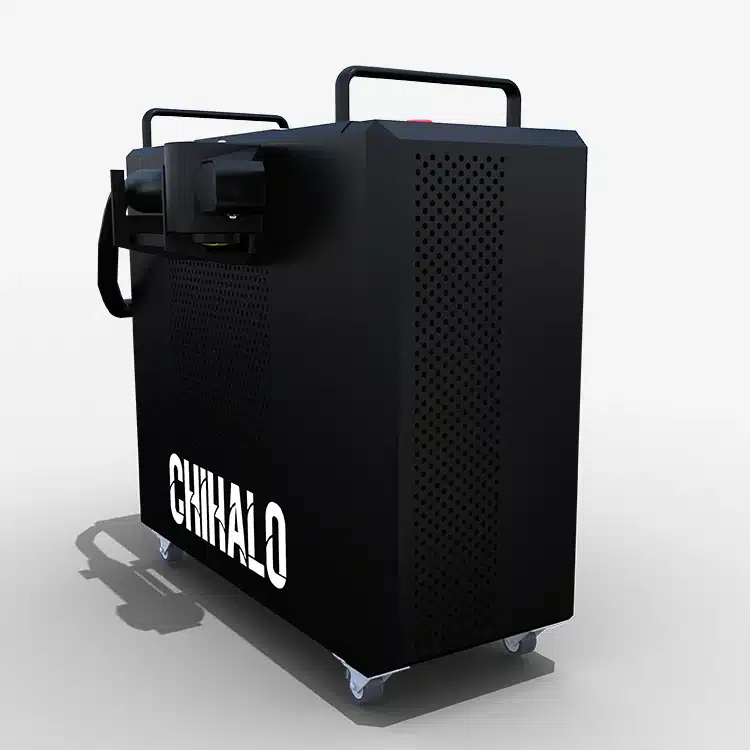
Chihalo Popular Laser Cleaners
Frequently Asked Questions
Laser finish removal is a non-contact cleaning process that uses high-energy laser beams to vaporize and remove paint, coatings, rust, and other surface contaminants without damaging the underlying material. It works through laser ablation—rapidly heating the unwanted layer until it sublimates (turns directly from solid to gas).
A pulsed laser beam targets the painted surface. The paint absorbs the laser energy, heating rapidly to its ablation threshold (typically 200-500°C). At this temperature, molecular bonds break and the paint vaporizes. The underlying metal, with a much higher ablation threshold, remains unaffected. Fume extraction captures the vaporized material.
Laser cleaning effectively removes: paint and primer, powder coating, e-coating (electrocoat), rust and oxidation, oil and grease, phosphate coatings, rubber residue, carbon deposits, and adhesive residue. It works on virtually any coating that absorbs laser energy.
No, when properly calibrated. Different materials have different ablation thresholds—the laser is tuned to reach the coating's threshold while staying below the substrate's. Metal substrates also reflect more laser energy than coatings, providing additional protection. The process is routinely used on aerospace components where any substrate damage would be unacceptable.
Yes. High-power continuous wave (CW) lasers (1,000-3,000W) can remove heavy rust and thick coatings at rates up to 360 ft²/hour. For very thick buildups, multiple passes may be needed. Some applications use a CW laser for bulk removal followed by a pulsed laser for final finishing.
Laser cleaning is significantly safer than sandblasting or chemical stripping. There's no silica dust exposure (silicosis risk), no chemical contact, and no hazardous waste handling. Operators need only laser safety glasses and should work within appropriate enclosures or behind laser safety curtains. Fume extraction handles any airborne particles.
For most applications, laser cleaning is superior: it's 5x faster in net process time, produces no hazardous waste, requires zero consumables, and achieves ±0.02mm precision vs ±2-5mm for sandblasting. Sandblasting may still be appropriate for very large outdoor areas (1,000+ ft²) where precision isn't critical.
Pulsed lasers (100-500W) deliver energy in short bursts, ideal for precision cleaning with minimal heat input—best for thin coatings and heat-sensitive materials. Continuous wave lasers (1,000-3,000W) deliver constant energy for maximum speed—best for heavy rust and thick coatings on robust substrates.
Match power to your coating and throughput needs: 100-200W for precision work on thin coatings (6-24 ft²/hr), 300-500W for general purpose cleaning (36-60 ft²/hr), 1,000W+ for heavy industrial applications (120-360 ft²/hr). When in doubt, consult with a laser cleaning specialist for application-specific recommendations.
Prices vary by power and configuration: portable handheld systems start around $15,000-$30,000 for 100W units, mid-range systems (200-500W) run $40,000-$100,000, and high-power industrial systems (1,000W+) range from $80,000 to $200,000+. Automated robotic cells can exceed $500,000 for turnkey installations.
Most operations achieve full ROI within 12-24 months. Key savings come from eliminated consumables ($5,000-$30,000/year), reduced waste disposal costs ($2,000-$10,000/year), and labor savings from faster processing and minimal setup/cleanup. Contact us for a customized ROI analysis for your operation.
Major industries include: automotive manufacturing (e-coating removal, EV battery production), aerospace and defense (hazardous coating removal, composite preparation), wood and furniture restoration, industrial mold and tooling maintenance, maritime (hull cleaning), infrastructure (bridge maintenance), and nuclear decontamination.
Basic operation is straightforward—most operators become proficient within hours. However, proper laser safety training is required, and understanding how to optimize parameters for different coatings improves results. Reputable suppliers provide comprehensive training as part of the purchase, including safety certification and application-specific guidance.
Get Your Factory-Direct Quote
Ready to skip the dealer markup? Contact us:
Tell us about your application and we’ll recommend the perfect solution:
Contact Information:
- 📧 Email: [info@chihalo.com]
- 📱 WhatsApp: [+86 18608325040]
Our technical team will respond within 24 hours with personalized recommendations and competitive pricing.