Laser Corrosion Removal: How It Works, Costs & Applications (2026 Guide)

Hi! I am Dawn. With 10 years of field experience, I specialize in laser cleaning systems—from optical sourcing to automation. I write here to turn complex specs into actionable buying guides.
Laser corrosion removal is a non-contact cleaning process that uses focused fiber laser beams (1064nm) to vaporize rust, oxide layers, and coatings from metal surfaces without damaging the substrate. It cleans 5–20 m² per hour, costs $0.10–$0.20 per m² to operate, produces zero chemical waste, and achieves Sa 2.5–3 surface cleanliness per ISO 8501-1. Machines range from $3,000 (entry-level) to $30,000+ (industrial automated systems).
Table of Contents
Rust and corrosion cost global industries over $2.5 trillion annually in equipment damage, maintenance, and replacement. Traditional removal methods—sandblasting, chemical stripping, and mechanical grinding—create toxic waste, damage surfaces, and slow down production lines.
There’s a better way.
Laser corrosion removal has emerged as the preferred solution for manufacturers, restoration specialists, and maintenance teams who need precision cleaning without the drawbacks of conventional methods. This comprehensive guide covers everything you need to know: how the technology works, what it costs, whether it’s right for your application, and how to choose the best system.
Whether you’re an engineer evaluating new surface preparation methods, a procurement manager comparing costs, or a business owner exploring equipment investments, this guide provides the data-driven insights you need to make an informed decision.
What Is Laser Corrosion Removal?
Laser corrosion removal is a non-contact, environmentally friendly cleaning process that uses focused high-energy laser beams to vaporize rust, oxide layers, paint, and other contaminants from metal surfaces without damaging the underlying material. Operating at wavelengths typically around 1064nm, the process achieves cleaning speeds of 5-20 m² per hour while producing zero chemical waste and requiring no abrasive media.
This technology is also known as laser ablation cleaning, laser rust removal, laser surface cleaning, and laser descaling. First developed for industrial applications in the 1990s, laser cleaning has evolved from a laboratory curiosity into a mainstream manufacturing solution used by automotive plants, aerospace facilities, shipyards, and restoration workshops worldwide.
How Does Laser Corrosion Removal Work?
- The laser generates high-energy pulses, typically lasting nanoseconds to microseconds, directed at the corroded surface.
- Rust and oxide layers have a lower ablation threshold than the base metal, meaning they absorb laser energy more readily.
- When the contamination layer absorbs sufficient energy, it rapidly heats to temperatures exceeding 2,500°C and vaporizes instantly.
- The underlying metal, having a higher ablation threshold, reflects most of the laser energy and remains undamaged.
Types of Lasers Used for Corrosion Removal
Two primary laser technologies are used in corrosion removal applications, each with distinct characteristics:
Pulsed Fiber Lasers represent the most common choice for rust and corrosion removal. They deliver energy in short, intense bursts that efficiently vaporize contaminants while minimizing heat transfer to the substrate. Power ranges from 20W to 2000W, with 100-500W being most popular for industrial applications. Average cost runs from $5,000 to $200,000 depending on power and features.
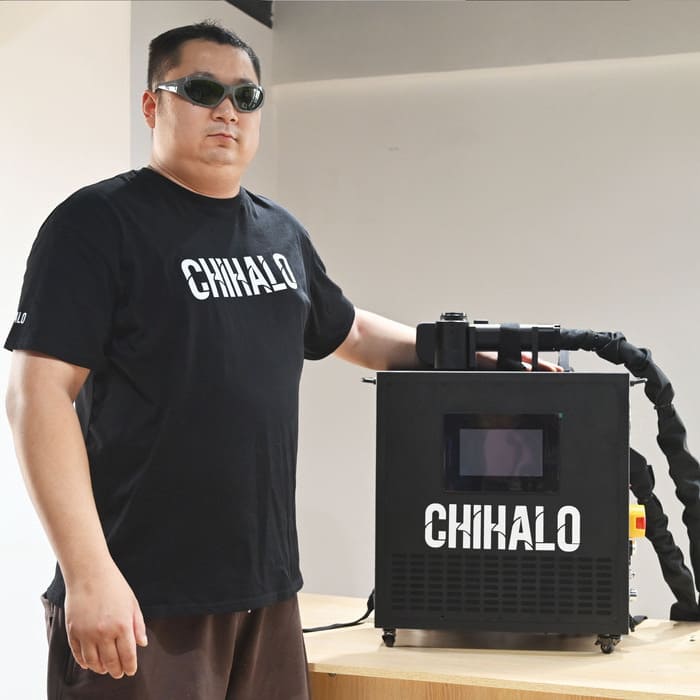
Continuous Wave (CW) Fiber Lasers emit a constant beam rather than pulses. They’re faster for heavy-duty applications like mill scale removal but transfer more heat to the workpiece. Power typically ranges from 1000W to 3000W, with costs from $5,000 to $12,000+. They’re best suited for thick rust, heavy scale, and high-volume production.
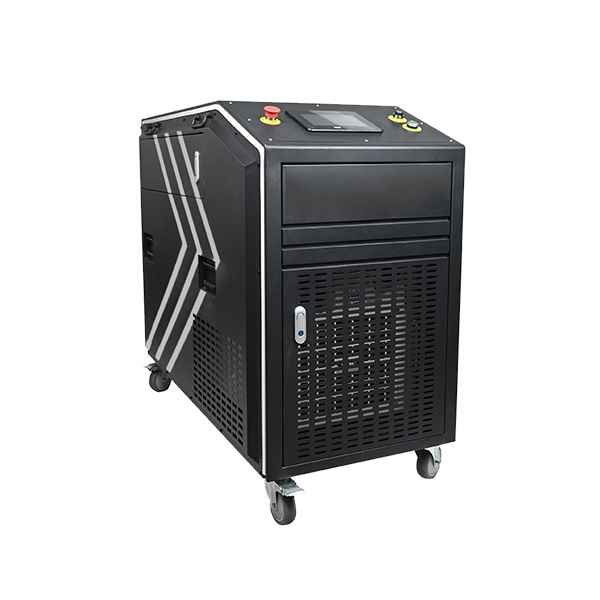
For most corrosion removal applications, pulsed fiber lasers offer the best balance of precision, efficiency, and cost-effectiveness.
Need help choosing between CW and pulsed? Read our laser rust removal machine buyer’s guide → for a detailed comparison.
Laser vs. Traditional Methods: Complete Comparison
Before investing in laser cleaning technology, you need to understand how it compares to the methods you may already be using. This section provides an objective, data-driven comparison.
Laser Cleaning vs. Sandblasting
Sandblasting (abrasive blasting) has been the industry standard for decades. Here’s how the two methods compare:
- Regarding surface quality, laser cleaning achieves Sa 2.5 to Sa 3 cleanliness (per ISO 8501-1) with consistent, repeatable results. Sandblasting typically achieves Sa 2.5, but quality varies based on operator skill, media type, and equipment condition.
- For environmental impact, laser cleaning produces zero abrasive waste, no silica dust, and only requires fume extraction. Sandblasting generates 2-5 kg of spent media per square meter cleaned, creating disposal costs and potential respiratory hazards.
- Looking at operating costs, laser cleaning requires only electricity at approximately $0.10-0.20 per m² for a 200W system. Sandblasting requires media at $0.50-2.00 per m², plus disposal fees and higher labor costs.
- Considering substrate protection, laser parameters can be precisely tuned to remove only the contamination layer. Sandblasting removes material from the substrate, typically 25-100 microns, which can be problematic for precision parts.
- On processing speed, a 200W laser cleans 5-10 m² per hour for moderate rust. Sandblasting can be faster at 10-20 m² per hour, but requires significant setup and cleanup time.
- Examining automation potential, laser systems integrate easily with robots and CNC controls for consistent, automated processing. Sandblasting automation is possible but more complex and less precise.
The key takeaway is that laser cleaning offers superior precision, environmental performance, and long-term cost savings. Sandblasting may still be preferred for very large areas with heavy contamination where precision isn’t critical.
Laser Cleaning vs. Chemical Cleaning
Chemical stripping uses acids, solvents, or alkaline solutions to dissolve rust and contaminants.
- For safety considerations, laser cleaning requires only standard laser safety glasses and fume extraction. Chemical cleaning requires extensive PPE, ventilation systems, and handling protocols for hazardous materials.
- Regarding environmental compliance, laser cleaning produces no liquid waste and typically requires only local exhaust ventilation. Chemical cleaning generates hazardous waste requiring licensed disposal, with costs ranging from $200-1,000 per drum, plus regulatory compliance burden.
- On processing time, laser cleaning provides immediate results with no dwell time required. Chemical cleaning requires 15-60 minutes of contact time, plus rinse and drying steps.
- Considering material compatibility, laser cleaning works on virtually all metals with appropriate parameter adjustment. Chemical cleaning requires different formulations for different metals, with risk of hydrogen embrittlement in high-strength steels.
- For process consistency, laser cleaning delivers identical results part after part with digital parameter control. Chemical cleaning results vary with solution concentration, temperature, and contamination level.
The key takeaway is that laser cleaning eliminates the regulatory burden, safety risks, and disposal costs of chemical cleaning while providing faster, more consistent results.
Laser Cleaning vs. Mechanical Cleaning
Mechanical methods include wire brushing, grinding, and power tool cleaning.
- For precision, laser cleaning removes contamination without affecting base metal dimensions. Mechanical cleaning removes substrate material and can create scratches, gouges, or uneven surfaces.
- Looking at labor intensity, laser cleaning can be fully automated or operated with minimal training. Mechanical cleaning is labor-intensive and results depend heavily on operator skill.
- Regarding access to complex geometries, the laser beam can reach internal surfaces, cavities, and complex shapes. Mechanical tools have limited access to internal features and complex geometries.
- Considering surface preparation quality, laser cleaning creates an ideal surface profile for welding, adhesive bonding, or coating. Mechanical cleaning may leave residues or create profiles unsuitable for subsequent processes.
- On consistency, laser cleaning provides identical results across thousands of parts with programmed parameters. Mechanical cleaning quality varies significantly between operators and over time.
The key takeaway is that laser cleaning is the clear choice for precision parts, complex geometries, and applications requiring consistent, documented surface quality.
Comparison Summary
When comparing all methods across key factors, laser cleaning earns top ratings for environmental impact, substrate protection, precision, automation readiness, and operating cost efficiency. Its main drawback is higher initial investment. Sandblasting excels only in initial investment cost, earning medium ratings elsewhere. Chemical cleaning scores lowest overall due to environmental concerns, safety requirements, and disposal costs. Mechanical cleaning offers low initial investment and moderate operating costs but falls short on precision, consistency, and automation potential.
How Much Does Laser Corrosion Removal Cost?
Cost is often the deciding factor in technology adoption. This section provides transparent pricing data to help you budget accurately.
Equipment Cost by Category
Entry-Level and Hobbyist Systems in the 20-100W range cost between $3,000 and $7,000. These are best for automotive restoration, small parts, and DIY projects. They offer portability and ease of use, with cleaning speeds of 0.5-2 m² per hour. Limitations include slower speed and limited duty cycle.
Small Business and Light Industrial Systems in the 100-200W range cost between $6,000 and $9,000. These suit job shops, maintenance departments, and small manufacturers. They offer a good balance of speed and precision, with cleaning speeds of 2-8 m² per hour. They require standard electrical supply and basic training.
Industrial Handheld Systems in the 200-500W range cost between $8,000 and $20,000. These are designed for production environments, large parts, and field service. They provide high speed with precision control, achieving cleaning speeds of 8-15 m² per hour. They typically require 3-phase power and professional installation.
Industrial Automated Systems in the 500W-1kW range cost between $20,000 and $30,000. These serve production lines, high-volume manufacturing, and continuous operation. They integrate with robots or gantry systems, achieving cleaning speeds of 15-25 m² per hour. They require systems integration and operator training.
Heavy-Duty Production Systems exceeding 1kW cost between $6,000 and $12,000+. These handle heavy scale, mill scale removal, and 24/7 production. They include full automation with multi-axis capability, achieving cleaning speeds exceeding 25 m² per hour. They require custom engineering, installation, and specialized training.
Operating Cost Analysis
Once you’ve purchased equipment, ongoing costs are remarkably low compared to traditional methods.
- Electricity costs for a 200W laser at $0.12/kWh running at 80% efficiency come to approximately $0.03 per operating hour, or about $0.006 per m² cleaned.
- For consumables, fiber lasers have no consumables. The laser source typically lasts 100,000+ hours, and protective windows need replacement every 2,000-5,000 hours at $50-200 each.
- Maintenance requirements are minimal, consisting of periodic optics cleaning and cooling system checks. Annual maintenance costs typically run $500-2,000.
- Labor costs remain similar to other methods for handheld systems. Automated systems can reduce labor by 60-80%.
The bottom line is that despite higher initial investment, laser cleaning costs 31% less over 5 years while eliminating waste disposal and environmental compliance burden.
ROI Calculation Framework
To calculate your specific ROI, use this formula: Annual Savings equals Current Cleaning Cost minus Laser Operating Cost, plus Waste Disposal Savings, plus Productivity Improvement Value, plus Quality Improvement Value. ROI in months equals Equipment Cost divided by Monthly Savings, multiplied by 12.
Most industrial users achieve full ROI in 12-24 months.
For a complete breakdown of laser cleaning costs including service rates and operating expenses, see our laser rust removal cost guide →
7 Key Benefits of Laser Cleaning
1. Environmentally Friendly: Zero Waste, Zero Chemicals
Laser cleaning eliminates 100% of the hazardous waste associated with traditional methods. There are no chemicals to purchase, store, or dispose of. There is no abrasive media waste, which can amount to 2-5 kg per m² for sandblasting. There is no contaminated wastewater. Operations produce only vaporized particles captured by fume extraction. This satisfies increasingly strict environmental regulations, including EPA and REACH requirements.
2. Precision Control: Micron-Level Accuracy
Laser parameters can be adjusted to remove specific contamination layers while preserving the base material. Selective removal down to 1-2 microns is possible. Operators can clean sensitive surfaces without dimensional changes. Digital parameter storage ensures repeatability across thousands of parts. The technology is ideal for precision aerospace, medical, and electronics components.
3. Non-Contact Process: No Mechanical Stress
Unlike abrasive and mechanical methods, laser cleaning applies no physical force to the workpiece. This means no scratching, gouging, or surface deformation. There is no risk of media embedment in soft metals. Complex geometries and delicate parts can be safely cleaned. Thin-walled components maintain structural integrity.
4. Superior Speed for Production Environments
Modern high-power laser systems match or exceed traditional methods. A 500W system cleans 15-20 m² per hour of moderate rust. Automated systems process parts 40-60% faster than manual methods. There is no setup or cleanup time between parts. Continuous operation capability enables 24/7 production.
5. Automation-Ready: Industry 4.0 Compatible
Laser cleaning integrates seamlessly with modern manufacturing systems. Robot integration is straightforward with standard interfaces. Digital parameter control enables recipe-based processing. Process monitoring provides quality documentation. Data logging supports traceability requirements.
6. Lower Long-Term Operating Costs
After initial investment, laser cleaning is remarkably economical. Electricity is the only ongoing consumable. Laser sources last 100,000+ hours, equivalent to 10+ years of typical use. Minimal maintenance requirements reduce downtime. No waste disposal costs exist over the equipment lifetime.
7. Safer Working Environment
Laser cleaning eliminates many hazards associated with traditional methods. There is no silica dust, a leading cause of respiratory disease in metal workers. There are no chemical exposure risks. Noise levels are significantly lower than sandblasting. Ergonomic handheld designs reduce operator fatigue.
Limitations: When Laser Cleaning Isn't the Best Choice
No technology is perfect for every application. Understanding limitations helps you make the right choice.
Heavy Rust and Scale
Laser cleaning works best on light to moderate corrosion. For rust layers exceeding 2mm thickness, multiple passes are required, increasing processing time. For heavy mill scale, consider a hybrid approach using mechanical pre-cleaning followed by laser finishing. Very heavy buildup may be more economical to remove with traditional methods first.
Very Large Surface Areas
For massive structures like ship hulls, bridge spans, or industrial tanks, laser cleaning may not be practical as the primary method. Handheld systems cover 5-20 m² per hour, making very large areas time-consuming. Equipment portability limits outdoor and field applications. For areas exceeding 1,000 m², sandblasting may remain more practical, though laser cleaning can be used for critical areas.
Budget Constraints
The initial investment is significant. Entry-level industrial systems start around $25,000-35,000. For very low volume applications, the payback period may be too long. Consider contract cleaning services as an alternative, typically available at $50-200 per hour. Leasing and financing options can spread the cost.
Certain Coating Types
Some materials require specialized parameters or may not be suitable. Thick ceramic coatings may require multiple passes. Some polymer coatings respond better to other methods. Multi-layer coating systems require careful parameter optimization. Always test on sample pieces before production.
Operating Environment
Environmental factors can affect performance. Outdoor operation requires weather protection for the laser source. Dusty environments may require additional optics protection. High-temperature environments may affect cooling system performance.
Honest Assessment
- Laser cleaning is NOT the right choice if your only need is occasional, small-area cleaning where a wire brush will do. It’s not ideal if your budget cannot accommodate minimum $15,000 investment. It’s not suitable if your application involves only very thick deposits exceeding 5mm where mechanical removal is faster. And it’s not appropriate if you lack access to electrical power in the work location.
- Laser cleaning IS the right choice if you need consistent, documented surface quality. It’s ideal if you’re facing environmental or regulatory pressure on current methods. It’s appropriate if you’re processing valuable parts where substrate protection matters. It works well if you have volume that justifies equipment investment. And it’s excellent if you want to reduce long-term operating costs.
Industry Applications
Automotive Manufacturing and Restoration
The automotive industry represents one of the largest markets for laser cleaning technology.
One major automotive supplier reported 38% faster processing time and 67% labor reduction after implementing laser cleaning for brake caliper preparation.
In manufacturing, laser cleaning handles pre-weld surface preparation for body panels, battery tray cleaning for EV manufacturing, mold cleaning for rubber and plastic components, and rust removal from stamped parts before coating.
For restoration, it addresses classic car body panel rust removal, engine block and component cleaning, chrome and trim piece restoration, and frame and chassis corrosion removal.
Aerospace and Defense
Aerospace applications demand the highest precision and documentation.
Specific applications include turbine blade cleaning and refurbishment, composite tooling mold maintenance, fastener hole preparation, coating removal for NDT inspection, and corrosion removal from aircraft structures.
The non-contact nature of laser cleaning is particularly valuable for expensive components where dimensional accuracy is critical. Major aerospace manufacturers including Boeing, Airbus, and their supply chains have adopted laser cleaning for various applications.
Marine and Shipbuilding
Shipyards and marine maintenance facilities use laser cleaning for hull surface preparation in targeted areas, weld preparation and post-weld cleaning, ballast tank maintenance, and offshore platform component refurbishment.
While full hull cleaning often uses traditional methods for speed, laser cleaning is increasingly used for critical areas requiring precise surface preparation, working around sensitive equipment, and achieving documented surface quality for protective coatings.
Oil, Gas, and Pipeline
The energy industry applications include pipeline weld preparation, valve and fitting maintenance, storage tank inspection preparation, and offshore platform maintenance.
Laser cleaning’s ability to create an ideal surface profile for coating adhesion makes it valuable for corrosion protection applications. The lack of waste generation simplifies offshore and remote location operations.
Historical Restoration and Conservation
Museums and restoration specialists value laser cleaning’s precision for bronze and iron artifact cleaning, architectural metalwork restoration, monument and statue conservation, and industrial heritage preservation.
The National Gallery, Smithsonian Institution, and numerous European museums have used laser cleaning to restore metal artifacts without risking damage to irreplaceable pieces.
Electronics and Precision Manufacturing
Micro-scale applications include circuit board contact cleaning, connector and terminal surface preparation, semiconductor equipment maintenance, and precision mold cleaning.
Low-power systems from 20-100W handle applications where surface contamination must be removed without affecting micro-scale features.
Technical Specifications Guide
Laser Power Selection
Choosing the right power level is critical for optimal results and cost-effectiveness.
- For light rust and oxide layers, systems from 50-100W are recommended.
- Typical applications include surface preparation, light oxidation, and precision parts.
- Cleaning speed ranges from 1-3 m² per hour, and suitable materials include all metals with thin contamination.
- For moderate corrosion, systems from 100-300W are recommended.
- Typical applications include general industrial cleaning, weld preparation, and coating removal.
- Cleaning speed ranges from 3-12 m² per hour, and suitable materials include steel, aluminum, and copper with moderate buildup.
- For heavy rust and scale, systems from 300-1000W are recommended.
- Typical applications include heavy industry, mill scale, and production lines.
- Cleaning speed ranges from 12-25 m² per hour, and suitable materials include carbon steel and cast iron with heavy deposits.
For production lines, systems from 1kW and above are recommended.
Typical applications include continuous processing, integrated manufacturing, and high-volume operations.
Cleaning speed exceeds 25 m² per hour, and suitable materials include various substrates at production speeds.
When in doubt, choose slightly higher power than minimum required for flexibility and faster processing when needed.
Key Parameters for Optimal Results
- Wavelength of 1064nm is standard for most metals, optimized for rust and oxide absorption while reflecting from clean metal surfaces.
- Pulse Duration in nanosecond pulses offers highest precision and minimal heat-affected zone. Microsecond pulses offer faster cleaning but more heat input.
- Pulse Frequency typically ranges from 3000 kHz for rust removal. Higher frequencies mean faster cleaning but lower peak power per pulse.
- Scan Speed from 1000-6000 m/s is typical. Faster scanning requires more passes, while slower scanning provides more thorough cleaning per pass.
Spot Size from 0.1-1mm is typical. Smaller spots mean higher precision but slower area coverage. Larger spots mean faster coverage but less precision.
Pulsed vs. Continuous Wave
- Pulsed Lasers offer precise energy control, minimal heat input, better for thin contamination, suitable for most corrosion applications, and represent the most common choice for rust removal.
- Continuous Wave Lasers offer faster for heavy deposits, provide more heat input to workpiece, are better for thick scale and heavy buildup, and are often used for high-volume production.
For most corrosion removal applications, pulsed fiber lasers provide the best balance of precision, efficiency, and versatility.
Top Equipment Brands Compared
Premium Industrial Brands
IPG Photonics is a USA-based market leader in fiber laser technology. Their power range spans 50W to 3kW. Price positioning is premium. Strengths include industry-leading reliability, extensive service network, and advanced features. Considerations include higher price point and corporate purchasing processes. Best for large manufacturers requiring maximum reliability and support.
Trumpf is a German company known as a European leader in industrial lasers. Their power range spans 100W to 2kW. Price positioning is premium. Strengths include outstanding build quality, comprehensive training, and excellent integration support. Considerations include premium pricing and longer lead times. Best for precision manufacturing and aerospace applications.
Coherent is a USA-based company established in laser technology. Their power range spans 50W to 1kW. Price positioning is premium. Strengths include strong technical support, proven industrial solutions, and good customization options. Considerations include complex product line. Best for R&D and specialized applications.
Mid-Range Industrial Brands
Pulsar Laser is a German-based company pioneering in laser cleaning. Their power range spans 50W to 1kW. Price positioning is mid-range. Strengths include purpose-built for cleaning, good application support, and European quality. Considerations include smaller US presence. Best for companies seeking proven cleaning-specific solutions.
Laserax is a Canadian company focused on marking and cleaning. Their power range spans 50W to 500W. Price positioning is mid-range. Strengths include North American support, good automation integration, and competitive pricing. Considerations include more limited power range. Best for North American manufacturers seeking local support.
Adapt Laser is a USA-based company specializing in rust removal. Their power range spans 100W to 2kW. Price positioning is mid-range. Strengths include application expertise, responsive support, and competitive pricing. Considerations include smaller company scale. Best for companies seeking specialist cleaning expertise.
Value-Oriented Brands
Chihalo Laser is a China-based major manufacturer. Their power range spans 50W to 3kW. Price positioning is value. Strengths include competitive pricing, wide power range, and extensive product line. Considerations include variable quality and support can be challenging. Best for budget-conscious buyers with technical expertise.
JPT is a China-based laser source manufacturer. Their power range spans 20W to 500W. Price positioning is value. Strengths include very competitive pricing and good availability. Considerations include integration required, with limited turnkey solutions. Best for system integrators and technically capable buyers.
Always request demonstrations on your actual materials before purchasing.
How to Choose the Right System
Step 1: Define Your Requirements
Assess your application: What materials are you cleaning? What type and thickness of contamination exists? What surface quality is required after cleaning? What is your daily or monthly processing volume?
Document your constraints: What is your available budget (equipment plus installation)? What is your available electrical power? Are there space limitations for equipment? Will the system be stationary or need to be portable?
Step 2: Calculate Required Power
Match power to your application using these guidelines. For light rust and oxidation on thin layers, aim for 50-100W to clean 1-3 m² per hour. For moderate rust with visible but not heavy buildup, aim for 100-200W to clean 3-8 m² per hour. For heavy rust with thick, flaking deposits, aim for 200-500W to clean 8-15 m² per hour. For scale and mill scale with industrial heavy deposits, aim for 500W or more to clean over 15 m² per hour.
Pro tip: Choose 25-50% more power than minimum required for flexibility and faster processing.
Step 3: Handheld vs. Automated
Choose handheld systems if you have varying part sizes and shapes, if volume is less than 1,000 parts per month, if flexibility is more important than speed, or if budget is under $100,000.
Choose automated systems if you have consistent part geometry, if volume exceeds 1,000 parts per month, if consistent quality documentation is required, or if integration with production line is needed.
Consider hybrid approach for companies processing both high-volume standard parts (automated) and varied maintenance work (handheld).
Step 4: Evaluate Suppliers
Request from each supplier: Live demonstration on your actual materials or similar samples. Detailed quotation including installation and training. Reference customers in similar applications. Service and support details for your region. Warranty terms and conditions. Lead time and delivery schedule.
Red flags to watch for: No local service capability. Reluctance to demonstrate on your materials. Vague or missing specifications. Pressure to purchase without demonstration. Significantly lower price than competitors (quality concerns).
Step 5: Total Cost of Ownership
Calculate full costs: Equipment purchase price. Shipping and import duties (if applicable). Installation and facility modifications. Training for operators and maintenance staff. Annual maintenance and consumables. Extended warranty if desired. Potential future upgrades.
Purchase Checklist
Before placing an order, confirm power level matches application requirements,
that handheld versus automated decision is finalized,
that you have obtained quotes from at least 3 suppliers,
that demonstrations on actual materials are completed,
that reference customers have been checked,
that service and support terms are understood,
that total cost of ownership is calculated,
that installation requirements are confirmed,
that training plan is established.
Frequently Asked Questions
Laser corrosion removal is a non-contact cleaning process that uses focused laser beams to vaporize rust, oxide layers, and contaminants from metal surfaces. The laser energy is selectively absorbed by the contamination layer, causing it to instantly vaporize, while the underlying metal reflects the laser and remains undamaged. This eco-friendly method requires no chemicals or abrasives, produces zero waste, and achieves cleaning speeds of 5-20 m² per hour depending on system power and contamination level.
The process relies on selective absorption of laser energy. Rust and oxide layers have a lower ablation threshold than clean metal, meaning they absorb laser energy more readily. When the contamination absorbs sufficient energy, it rapidly heats to over 2,500°C and vaporizes. The base metal, having a higher ablation threshold, reflects most of the laser energy and stays cool and undamaged. A fume extraction system captures the vaporized particles, leaving a clean, oxide-free surface.
For most precision applications, yes. Laser cleaning offers superior surface quality with consistent Sa 2.5 to Sa 3 cleanliness, zero waste disposal costs, no substrate damage, and lower long-term operating costs. However, sandblasting may still be faster for very large areas with heavy contamination where precision isn't critical. The best choice depends on your specific application, volume, and quality requirements.
Prices range from $3,000-$12,000 for entry-level 20-100W hobby and automotive units, $12,000-$35,000 for small business 100-200W systems, $35,000-$100,000 for industrial handheld 200-500W systems, and $80,000-$500,000+ for automated industrial systems above 500W. The right investment depends on your application, processing volume, and required capabilities.
Power selection depends on contamination severity. For light rust and thin oxide layers, choose 50-100W. For moderate corrosion and general industrial use, choose 100-300W. For heavy rust, scale, and production environments, choose 300W-1kW. For high-volume production with thick deposits, choose systems over 1kW. When uncertain, choose slightly higher power for flexibility and faster processing.
When properly configured, no. The laser parameters—power, pulse duration, and frequency—are set based on the material's ablation threshold. Since rust has a lower threshold than the metal, it vaporizes first while the metal remains intact. Proper parameter selection ensures the base material is unaffected. This is why testing on sample materials is always recommended before production.
Laser cleaning works on most metals including carbon steel, stainless steel, aluminum, copper, brass, bronze, and titanium. It can also clean stone, concrete, and some plastics with appropriate parameter adjustment. Each material requires specific settings optimization. Highly reflective metals like polished aluminum may require parameter adjustment for effective cleaning.
Yes, it's one of the most environmentally friendly cleaning methods available. Laser cleaning produces zero chemical waste, requires no abrasive media, and generates no contaminated wastewater. The only byproduct is vaporized contaminants captured by a fume extraction system. This eliminates hazardous waste disposal costs, typically $200-1,000 per drum for chemical waste, and simplifies environmental compliance.
Speed depends on laser power and contamination level. A 200W laser cleans 5-10 m² per hour of moderate rust. A 500W system achieves 15-20 m² per hour. This is comparable to sandblasting for many applications, but laser cleaning requires minimal setup and cleanup time. When factoring total process time including preparation and cleanup, laser cleaning often proves faster overall.
Yes, but heavy contamination requires higher power (300W+) and may need multiple passes. For rust layers exceeding 2mm, processing time increases significantly. For extremely thick scale, a hybrid approach—mechanical pre-cleaning followed by laser finishing—may be more cost-effective. Testing on representative samples determines the optimal approach for your specific contamination.
Essential safety equipment includes laser safety glasses matched to the 1064nm wavelength, a fume extraction system to capture vaporized particles, appropriate enclosure or controlled area for Class 4 lasers, and standard PPE including gloves and appropriate clothing. Operators require training on laser safety, and facilities may need safety interlocks and warning signage depending on laser class and local regulations.
The fiber laser source typically lasts 100,000+ operating hours—equivalent to over 10 years of single-shift operation. Protective optics require periodic replacement (every 2,000-5,000 hours) at minimal cost. With proper maintenance, the overall system can operate 15-20 years. Fiber lasers are particularly durable with no consumable parts like flash lamps found in older laser types.
Absolutely—this is one of the most common industrial applications. Laser cleaning creates an ideal surface for welding by removing oxides, oils, and contaminants that cause weld defects. For coating applications, laser cleaning produces a consistent surface profile and cleanliness level that improves coating adhesion. Many manufacturers use laser cleaning specifically for pre-weld and pre-coat preparation.
Yes, lower-power portable units from 20-100W are available for hobbyists and small businesses at $3,000-$12,000. These systems are suitable for automotive restoration, metal sculpture, furniture restoration, and small fabrication projects. They operate on standard household power and are designed for safe operation with basic training. However, users must still follow laser safety protocols and use appropriate eye protection.
Laser cleaning systems require minimal maintenance compared to other industrial equipment. Regular requirements include daily inspection and cleaning of protective optics, periodic cleaning of cooling system filters, annual inspection and service of scanning head, and fume extraction system filter replacement as needed. Total annual maintenance costs typically run $500-2,000 for industrial systems, significantly less than the ongoing costs of consumables for traditional cleaning methods.
Get Your Factory-Direct Quote
Ready to skip the dealer markup? Contact us:
Tell us about your application and we’ll recommend the perfect solution:
Contact Information:
- 📧 Email: [info@chihalo.com]
- 📱 WhatsApp: [+86 18608325040]
Our technical team will respond within 24 hours with personalized recommendations and competitive pricing.